Tesla PPF Installation Guide 2026: DIY Paint Protection Film
Paint Protection Film (PPF) is the most effective way to shield your Tesla's paint from stone chips, road debris, and swirl marks. Professional full-car installation costs €4,000–9,000 in Europe — but a strategic DIY approach (front bumper + hood edges) costs under €300 and protects 80% of the high-impact area.
Quick-answer summary:
| Coverage Area | DIY Kit Cost | Pro Install | Time (DIY) | Difficulty |
|---|---|---|---|---|
| Door edge guards | €30–60 | €150–250 | 1–2 hrs | Easy |
| Front bumper | €80–150 | €400–700 | 3–5 hrs | Medium |
| Full hood | €120–220 | €600–1,000 | 3–4 hrs | Hard |
| Mirrors (pair) | €40–80 | €200–350 | 1.5–2 hrs | Medium |
| Full front package | €300–600 | €1,500–2,500 | 12–18 hrs | Very Hard |
| Full car | €1,000–2,000 | €4,000–9,000 | 20–40 hrs | Expert |
Table of Contents
- Should You Get PPF? Decision Guide
- Understanding PPF: Film Types and Specs
- Best PPF Brands for Tesla (2026)
- PPF vs Ceramic Coating vs Vinyl Wrap
- Model-Specific Coverage Guide
- Matte and Satin PPF Options
- Tools and Materials
- Surface Preparation
- Step-by-Step Application
- Model 3 Highland and Model Y Juniper Differences
- From the Workshop: Real PPF Cases
- Common DIY Mistakes
- After Installation: Care Calendar
- PPF Removal and Replacement
- DIY vs Professional
- Where to Buy PPF in Europe
- FAQ
Should You Get PPF? Decision Guide
Before spending €100–9,000, use this matrix to confirm PPF makes sense for your situation:
| Your Situation | Best Coverage | Estimated DIY Cost |
|---|---|---|
| New Tesla, garage-parked, light use | Door cup inserts + front bumper lower | €100–200 |
| New Tesla, outdoors, northern EU/Canada/UK | Full front package (bumper + hood + fenders) | €300–600 |
| Used Tesla, chips already present | Fix chips first, then door cups | €150–250 |
| Daily driver, business use, plan 5+ years | Full front package minimum | €300–600 |
| Track or mountain road driving | Front bumper + hood + mirror caps | €300–500 |
| Model S or X (complex curves) | Professional only | €2,000–5,000 pro |
| Cybertruck | Door cup inserts + rear bumper only (painted areas) | €50–120 |
PPF ROI in Northern European conditions:
PPF protects against the two biggest causes of resale value loss on a used Tesla in Lithuania, Germany, or the Nordics:
- Stone chips on the hood and bumper — visible from 2 meters, devalues the car by €500–2,000 at trade-in
- Door cup paint transfer — the single most-complained-about cosmetic issue on Model 3 and Model Y
A DIY full front package (€300–600) on a new Tesla pays for itself in preserved resale value within 3 years of driving in salt-exposed conditions. If you plan to own the car fewer than 2 years, skip PPF and use a ceramic coating instead — the cost-per-year math favors ceramic for short ownership windows.
For a direct comparison of all three protection options: PPF vs Ceramic Coating vs Vinyl Wrap.
Understanding PPF: Film Types and Specs
Film Specifications That Matter
| Spec | What to Look For | Why It Matters |
|---|---|---|
| Thickness | 8 mil (200 microns) | Thicker = more chip resistance |
| Self-heal temp | ≤60°C | Lower = heals more easily in EU summer sun |
| Clarity | >95% optical clarity | Invisible on light colors |
| UV resistance | 10-year no-yellowing warranty | Non-yellowing formulas matter for light/white paint |
| Hydrophobic coating | Top-coat included | Water beads off, easier to clean |
Pre-Cut Kits vs. Bulk Film
Pre-cut kits (recommended for DIY):
- Computer-cut precisely for your Tesla model and year
- No cutting required — just peel, position, and squeegee
- Cost 30–50% more than bulk but drastically reduce waste and errors
- XPEL, SunTek, and 3M all offer Tesla-specific pattern libraries
Bulk film rolls (professional/advanced):
- Requires a plotter or hand-cutting with a professional blade
- Much higher skill ceiling — one wrong cut wastes €30–80 of film
- Only worthwhile if you plan to do multiple vehicles
Best PPF Brands for Tesla (2026)
| Brand | Film | Thickness | Self-Heal Temp | Warranty | DIY Kit Available | EU Price (hood) |
|---|---|---|---|---|---|---|
| XPEL | Ultimate Plus | 8 mil | 60°C | 10 years | ✅ | €180–260 |
| SunTek | Ultra | 8 mil | 60°C | 10 years | ✅ | €150–220 |
| 3M | Pro Series 200 | 8 mil | 65°C | 5 years | ✅ | €130–190 |
| LLumar | Platinum | 8.5 mil | 60°C | 10 years | Limited | €160–240 |
| Hexis | Bodyfence | 7.5 mil | 60°C | 7 years | ✅ (EU-focused) | €130–200 |
Recommendation: XPEL Ultimate Plus for best performance. SunTek Ultra for better value with near-identical specs. Hexis Bodyfence is a strong EU-manufactured option with good local distributor support in Germany, France, and the Nordics.
PPF vs Ceramic Coating vs Vinyl Wrap
These three products are often confused. They protect differently, cost differently, and serve different roles. Buying the wrong one is a €1,000–3,000 mistake:
| Factor | PPF | Ceramic Coating | Vinyl Wrap |
|---|---|---|---|
| Primary function | Absorbs stone chips and impacts | UV, chemical, and swirl resistance | Color change + moderate protection |
| Thickness | 8 mil (200 microns) | 1–5 microns | 90–130 microns |
| Chip protection | Excellent — physically absorbs impact | None (too thin) | Moderate |
| Self-healing | Yes — scratches heal at 60°C | No | No |
| Hydrophobic | Yes (built-in top coat) | Excellent | Moderate |
| Finish options | Clear gloss, matte, satin | Clear only | Full color and finish range |
| DIY difficulty | Hard | Medium | Hard |
| Lifespan | 7–10 years | 2–5 years | 3–7 years |
| EU cost — full car (pro) | €4,000–9,000 | €600–1,500 | €1,500–4,000 |
| EU cost — front package (pro) | €1,500–2,500 | €200–500 | €400–900 |
The professional-grade combination: PPF on the front 30–40% of the car (bumper, hood, fenders, mirror caps) + ceramic coating applied over the PPF + ceramic on all remaining painted surfaces. This stack is standard practice among high-mileage Tesla owners and professional detailers across Northern Europe and North America.
When ceramic beats PPF: Planning to own the car 2 years or fewer, driving mostly on clean motorways, no chip damage yet. Ceramic's annual cost is 5–10× less than PPF.
When vinyl beats PPF: Wanting a color change or matte finish on a lower budget, accepting reduced chip protection, 3–5 year commitment rather than 10.
See the full ceramic coating guide for Tesla and vinyl wrap guide for installation details on those alternatives.
Model-Specific Coverage Guide
Different Tesla models have different high-impact zones based on their geometry and ride height:
| Model | Most Vulnerable Areas | Kit Complexity | Notes |
|---|---|---|---|
| Model 3 (2017–2023) | Front bumper lower lip, hood leading edge, door cups | Medium | Door cup paint transfer is the #1 complaint |
| Model 3 Highland (2024+) | Redesigned front bumper, hood, side cameras | Medium-Hard | Different kit vs. pre-2024 — verify compatibility |
| Model Y (2020–2023) | Front bumper, rocker panels (lower), hood | Medium | Higher ride height = less lower-bumper chip damage than M3 |
| Model Y Juniper (2024+) | Redesigned front + aerodynamic lip | Hard | Juniper-specific kits released mid-2024 |
| Model S | Full front end, complex hood curves, side cameras | Hard | Curved surfaces require professional heat stretching |
| Model X | Front bumper, falcon wing door seals, full hood | Expert | Falcon wing door edges lift easily — professional only |
| Cybertruck | No traditional PPF — stainless steel body | N/A | Ceramic coating only — PPF does not adhere well to brushed SS |
Door Cup Inserts: Model 3 and Y Priority Fix
The painted door cup area (where you press to open) is the most-scratched spot on both Model 3 and Model Y. A targeted door cup PPF insert kit costs €25–40 and takes 15 minutes per door. This is the single highest-ROI DIY PPF job for any Tesla.
Matte and Satin PPF Options
Standard PPF is clear gloss — invisible on the paint. Matte and satin PPF films have become mainstream, especially on black, gray, and Midnight Silver Teslas where owners want to change the finish without a full vinyl wrap.
Available Finishes in 2026
| Finish | Effect | Best Brand | EU Hood Kit | Notes |
|---|---|---|---|---|
| Gloss clear | Invisible — enhances existing gloss | XPEL Ultimate Plus | €180–260 | Standard choice for all colors |
| Matte clear | Converts gloss paint to flat matte | XPEL Stealth | €200–320 | Most popular matte option in Tesla community |
| Satin clear | Midpoint between gloss and matte | SunTek ClearSight Matte, Hexis Bodyfence Satin | €170–290 | Subtle finish shift; works well on white |
XPEL Stealth is the dominant matte PPF for Tesla. It produces a flat, non-reflective finish while retaining the full 8 mil chip protection and 60°C self-healing of the standard Ultimate Plus film. Pre-cut Tesla-specific kits are available.
EU source: XPEL Stealth matte PPF for Tesla on Amazon.de
US source: Matte PPF for Tesla on Amazon.com
Three Rules for Matte PPF
-
Cover the full panel: Applying matte PPF to only half a hood creates a visible finish mismatch at the film edge. Matte PPF must cover the entire visible surface of any panel where it is applied — partial coverage looks wrong regardless of how well it is installed.
-
No conventional wax or ceramic sealant: Standard waxes and ceramic coatings will create gloss patches on a matte surface, permanently altering the finish in the treated areas. Use only a matte-compatible spray sealant (available from detailing suppliers — apply every 3 months).
-
Self-healing is unchanged: The self-healing mechanism is in the film body, not the matte top coat. XPEL Stealth heals minor scratches at the same 60°C threshold as standard gloss PPF.
Tools and Materials
Essential Supplies
| Item | Spec | EU Source |
|---|---|---|
| Pre-cut PPF kit | Model and year specific | Amazon.de |
| Heat gun (2000W, variable) | 40–80°C adjustable | Amazon.de |
| PPF squeegee set | Soft felt + hard rubber | Amazon.de |
| Clay bar kit | Fine grade | Amazon.de |
| Isopropyl alcohol 99% | 1L minimum | Amazon.de |
| Microfiber towels | 20+ pack | Amazon.de |
| Slip solution | Baby shampoo + distilled water (DIY) or pre-mixed | Any detailing shop |
| Spray bottles (×2) | 1L each | Hardware store |
| Trim removal tools | Plastic, not metal | Amazon.de |
US buyers: Tesla PPF kits on Amazon.com
Workspace Requirements
- Temperature: 15–25°C (59–77°F) — below 15°C adhesive won't bond; above 30°C film becomes too tacky
- Humidity: 40–60% relative humidity
- Lighting: At least 1,000 lux — work lights on either side of the panel, not overhead
- Cleanliness: Closed garage, no fans running, floors wetted down to suppress dust
- Time blocks: Never start a panel unless you have 4 hours uninterrupted
Surface Preparation
Preparation accounts for 70% of the result quality. Anything on the paint surface gets permanently sealed under the film.
Step 1: Two-Bucket Wash (30 minutes)
- Pre-rinse the entire car with low-pressure water to lift loose debris
- Wash with pH-neutral car shampoo using a two-bucket method (wash + rinse bucket)
- Pay extra attention to panel shut lines and under-lip areas where debris hides
- Rinse completely and dry with a clean microfiber
Step 2: Iron Decontamination (15 minutes)
- Spray an iron fallout remover across the panel — liquid turns purple on contact with embedded iron particles
- Rinse thoroughly
- Inspect for remaining contamination — metallic specs visible against light
Step 3: Clay Bar Treatment (20–30 minutes per panel)
- Spray panel with clay lubricant
- Work the clay bar in overlapping passes using light pressure
- Panel should feel glass-smooth when done — rough = more contamination still present
- Fold and re-knead clay frequently; discard if dropped
Step 4: IPA Panel Wipe (5 minutes per panel)
- Mix 50% IPA + 50% distilled water in a spray bottle
- Spray and wipe panel with a clean microfiber — use a fresh microfiber fold for each pass
- Do not touch the paint with bare hands after this step
- Let dry completely (3–5 minutes) before film application
Step-by-Step Application
Slip and Tack Solutions
Slip solution (positioning):
- 1 liter distilled water
- 8 drops baby shampoo (no conditioner, no aloe)
- Mix gently — avoid foam
Tack solution (final set):
- 150ml distilled water
- 50ml IPA 99%
- Used in the final squeegee pass to help adhesive activate
Step 1: Pre-Stage the Film (5 minutes)
- Lay the pre-cut film piece on a clean, dry surface backing-side up
- Confirm orientation against the panel before peeling
- Spray the backing paper with slip solution (not the adhesive side yet)
Step 2: Peel and Spray
- Peel 5–10cm of backing paper from one edge
- Spray the exposed adhesive with slip solution immediately
- Continue peeling in sections of 10–15cm, spraying as you go
- Never expose more than 30cm of adhesive at once outdoors
Step 3: Position on Panel
- Generously spray the paint surface with slip solution
- Lay the film on the panel — it will float and remain repositionable for 30–60 seconds
- Align using reference marks (edge of headlight, corner of bumper cap)
- Work from largest reference point to smallest
Step 4: Initial Squeegee Pass
- Start at the center of the panel
- Use a soft felt squeegee with gentle, overlapping strokes toward the edges
- Apply consistent pressure — not heavy — to push solution out
- Wipe excess solution off the surface as you go with a microfiber
Step 5: Stretching Curves (Heat Gun Technique)
For curved areas (bumper corners, mirror caps):
- Set heat gun to LOW (40–50°C air temperature — hold your hand 15cm away, should feel warm but not hot)
- Keep the gun moving in sweeping passes — never stationary
- Heat 10–15 seconds, then squeegee while film is warm and pliable
- Work in small 5cm sections around curves
- Surface temp goal: 45–55°C — use an IR thermometer if available
Step 6: Edge Finishing
- Squeegee firmly toward all edges — no solution trapped at the perimeter
- For wrapped-edge installations: use a plastic trim tool to tuck the film under the bumper or hood edge (heat the film slightly first)
- For overlap-edge installations: squeegee to within 2mm of the edge; do not try to fold it
- Apply a final pass of tack solution and squeegee dry
Step 7: Post-Install Inspection
Check immediately using a side-light inspection lamp:
- Water bubbles (small, <2mm): Normal — will disappear within 7–14 days
- Air bubbles: Use a fine needle at a 45° angle; gently squeegee flat; if they return, the adhesive has released and the section must be reapplied
- Lifting edges: Apply heat and firm squeegee pressure; if still lifting, apply a small amount of tack solution under the edge
Model 3 Highland and Model Y Juniper Differences
The 2024 Model 3 Highland and 2024 Model Y Juniper both received redesigned front bumpers with:
- A lower aerodynamic lip that extends further forward (more chip-prone)
- Integrated camera housings in new positions
- Revised hood-to-bumper junction angles
Critical: Pre-2024 PPF kits do not fit. Verify your kit explicitly lists "2024+" or "Highland/Juniper" in the description. XPEL and SunTek both updated their pattern databases by Q3 2024 — older third-party resellers may still carry outdated cuts.
For the Highland, the front bumper lower section takes 4–5 hours for a first-time installer due to the multi-compound curve at the air intake corners.
From the Workshop: Real PPF Cases
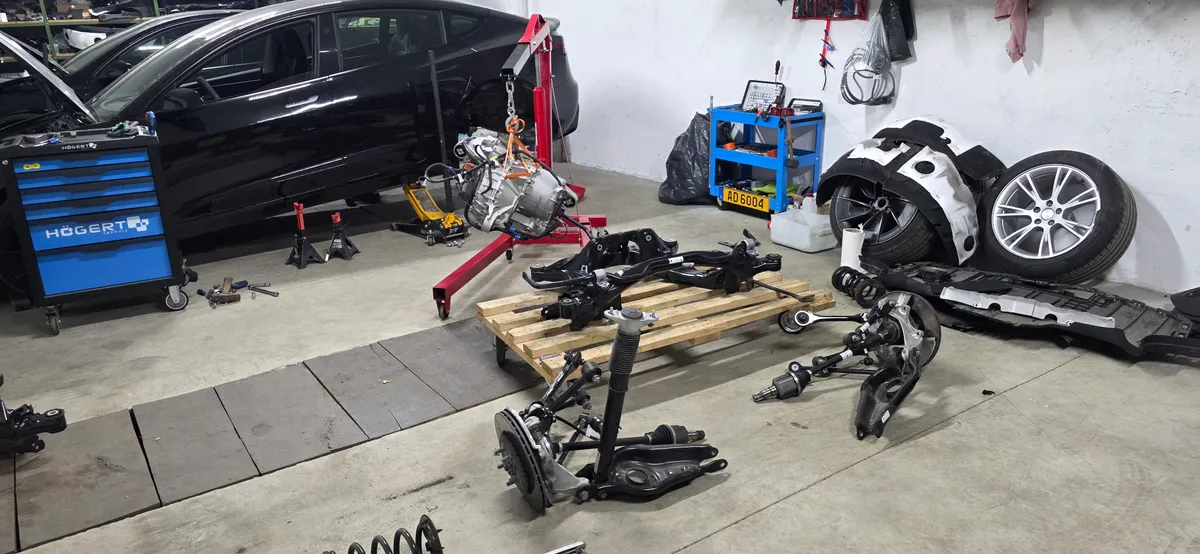
At RR Car Parts in Kaunas (a Tesla OEM parts supplier), we see PPF-related damage regularly:
Case 1 — Model 3 (2022), 47,000 km: Customer reported paint chips on leading hood edge despite having aftermarket PPF installed. Inspection revealed the film had lifted at the hood-to-fender junction — a sign of edge-overlap installation rather than a wrapped edge. Moisture had crept under the film, causing an adhesive failure zone ~8cm wide. The film had to be professionally removed and the paint touched up before re-application.
Case 2 — Model Y (2021), 62,000 km: Bubbling visible across the full front bumper one summer after DIY installation. The cause: film installed on a day when the panel was in direct sunlight and above 28°C. Adhesive set unevenly, creating micro-air pockets that expanded in subsequent heat. The bumper section required full removal and replacement — €150 in new film plus 4 hours of labor.
Case 3 — Model S (2019), 94,000 km: Customer attempted DIY full hood with bulk film. Result: visible stretch marks along both A-pillars and the complex central swage line. Professionally installed film costs €900–1,100 for a Model S hood. The DIY attempt required professional remediation at €600 before acceptable re-application.
Lesson: Complex curves (full bumper, full hood on Model S) are professional territory. The Model 3 door edge inserts and rear bumper load area are genuinely DIY-friendly starting points.
Common DIY Mistakes
Mistake 1: Cold Garage (<15°C)
Adhesive won't bond below 15°C surface temperature. The film appears to stick but fails within weeks as temperature cycles. Minimum: warm the garage to 18°C for 2 hours before installation.
Mistake 2: Overheating (>70°C surface)
PPF adhesive begins to degrade above 70°C surface temperature. Excessive heat gun use leaves permanent stretch marks and can cause the protective top coat to dull. Set your heat gun to LOW and keep moving.
Mistake 3: Insufficient Slip Solution
Under-lubricated film sticks on contact. You lose all repositioning ability. The solution: use more slip solution than feels necessary. The film should glide freely across the paint.
Mistake 4: Working in Sections Too Large
On a Model Y hood (1.4m wide), applying the full piece at once is extremely difficult solo. Experienced installers work in 2-person teams on large panels. Solo: fold the film and work half at a time.
Mistake 5: Skipping the IPA Wipe
Any wax, silicone, or detailing spray residue prevents adhesion. Always IPA-wipe even if the paint looks clean.
After Installation: Care Calendar
| Timeframe | Do | Don't |
|---|---|---|
| 0–48 hours | Park in shade, leave undisturbed | Wash, touch edges, drive in rain |
| 2–7 days | Light rinse with low pressure | Pressure washer, touchless wash |
| 7–30 days | Hand wash with pH-neutral soap | Automatic car wash, wax, sealant |
| 30+ days | Apply ceramic coating over PPF if desired | Abrasive polishes or compounds |
| Ongoing | pH-neutral wash only, inspect edges quarterly | Solvent-based cleaners, petrol spills on film |
To activate self-healing on light scratches: park in direct sunlight for 20–30 minutes, or use a heat gun on LOW (40°C air temp) held 20cm from the surface for 30 seconds per scratch.
PPF Removal and Replacement
Quality PPF lasts 7–10 years. After that — or sooner if the film was installed poorly — it needs to come off. Removal is a normal part of the PPF lifecycle, not an emergency procedure.
Signs Your PPF Needs Replacing
- Yellowing: Visible amber tint on the clear film, most obvious on white or silver paint; accelerated by years of UV exposure. A good sign that the top coat has degraded.
- Edge lifting: Film peeling back at the hood leading edge, bumper lower lip, or door cup edges — the most common long-term failure mode.
- Delamination: Air pockets between film layers that don't compress (distinct from the normal post-install adhesive bubbles that self-resolve in 7–14 days).
- Orange peel texture developing: Film surface has rippled across a large area, indicating adhesive failure or poor original installation.
- Scratches not self-healing: Physical damage that cut through the protective top coat into the film body — the self-healing function only covers the top coat layer.
DIY PPF Removal Procedure
| Step | Method | Time per Panel |
|---|---|---|
| Heat the film edge | Heat gun at 50–60°C surface temp on a corner for 30 seconds | 5 min prep |
| Peel at low angle | Pull at 15–20° — never straight up; high angle tears the film and leaves adhesive | 15–30 min |
| Remove adhesive | 99% IPA or dedicated adhesive remover (Gtechniq W6, CarPro Tar X) | 10–20 min |
| Clay bar | Clay bar the bare paint to eliminate all residue | 10–15 min |
Per-panel time: Front bumper 30–45 min. Hood 45–60 min. Full car 1.5–2 days.
Critical warning for older paint: On a Tesla with 5+ years of age, or any panel that has had paint repair (accident, respray), test PPF removal on a small hidden area first — try the rear bumper lower edge or inside a door jamb. If any clear coat lifts with the film during the test, stop. The adhesive bond has become stronger than the paint-to-metal adhesion, and full DIY removal risks paint damage. Have a professional detailer handle the removal.
After removing old PPF, inspect for chips or scratches that developed under the film. Address those with the paint chip repair guide or scratch repair guide before applying new film.
EU removal supplies: PPF adhesive remover + clay bar on Amazon.de
US removal supplies: PPF adhesive remover on Amazon.com
DIY vs Professional: Realistic Assessment
| Aspect | DIY | Professional |
|---|---|---|
| Cost | €200–600 (partial) | €1,500–9,000 (partial to full) |
| Time | 8–40 hours | 1–4 days (you leave the car) |
| Result quality | Variable (1st attempt: 70–85% of pro) | Consistent, warranty-backed |
| Warranty | None | 5–10 years against yellowing/delamination |
| Error recovery | Buy more film (€80–200 per mistake) | Included |
| Best for | Door edges, rear bumper load area, mirrors | Full bumper, full hood, full car |
Where to Buy PPF in Europe
| Source | Best For | Notes |
|---|---|---|
| Amazon.de | Full pre-cut kits + tools | Fast delivery to all EU; widest selection |
| XPEL Europe (xpel.com/find-a-dealer) | Premium pre-cut kits | Order through local certified dealer for warranty coverage |
| SunTek Europe (suntek.com) | Competitive pre-cut kits | 10–15% cheaper than XPEL with near-identical specs |
| Autodoc.de | Prep supplies (clay bar, IPA, squeegees) | Best pricing on consumables; ships EU-wide |
| Folientechnik.de (DE) | Bulk film + professional tools | Best for German buyers wanting professional-grade stock |
| Wrapsol.com (PL) | Polish-sourced pre-cut kits | Fast delivery to Baltic states and Eastern EU |
| RR Car Parts (rrcarparts.lt) | Tesla OEM parts before PPF application | Fix chips before protecting — see paint chip repair guide |
EU professional installation price benchmarks by country (2026):
| Country | Front Package (pro) | Full Car (pro) | Notes |
|---|---|---|---|
| Germany | €1,800–2,800 | €5,000–9,000 | Premium labour market; Berlin and Munich have specialist EV detailers |
| Lithuania | €900–1,600 | €2,800–5,500 | Best value in EU for quality work; strong Tesla OEM parts access |
| Poland | €1,200–2,000 | €3,500–7,000 | Growing PPF installer network; Warsaw and Kraków strongest |
| Netherlands | €1,600–2,500 | €4,500–8,000 | Multiple XPEL-certified EV specialists in Amsterdam area |
| Sweden | €2,000–3,200 | €6,000–10,000 | Highest labour cost in EU |
| UK | £1,500–2,500 | £4,500–8,500 | Strong PPF market; numerous XPEL/SunTek certified installers nationwide |
For DIY buyers in Lithuania, Latvia, Estonia, and Poland: Amazon.de ships pre-cut kits within 3–5 business days at no import duties (EU single market).
For US buyers: XPEL and SunTek kits on Amazon.com
FAQ
How much does Tesla PPF cost in 2026? DIY partial coverage: €80–600 depending on area. Professional full-car: €4,000–9,000 in Western Europe. The front bumper is the highest-value DIY target — it protects the most chip-prone area for €80–150 in film.
What is the best PPF brand for Tesla? XPEL Ultimate Plus leads for quality and durability (8 mil, self-heals at 60°C, 10-year warranty). SunTek Ultra offers near-identical performance for 15–20% less cost. Both offer Tesla-specific pre-cut pattern libraries including 2024+ Highland and Juniper fitments.
Does PPF self-heal on its own in Lithuanian/EU summers? Yes. In Central and Eastern Europe, dark panel surface temperatures regularly reach 55–65°C in July and August — sufficient to trigger self-healing in XPEL Ultimate Plus and SunTek Ultra. Light scratches from carwash brushes or fingernail marks will heal naturally after 20–30 minutes of direct sun exposure.
Can I apply ceramic coating over PPF? Yes, and it's recommended. A ceramic coating over PPF adds hydrophobic protection, makes the film easier to clean, and gives a high-gloss finish. Wait at least 30 days after PPF installation before applying ceramic. Use a ceramic product specifically rated as PPF-compatible.
Do I need to remove the front bumper to install PPF? For a wrapped-edge installation (the only approach that holds long-term), yes — you'll need to partially remove the bumper to tuck the film edges underneath. See our Tesla front bumper removal guide for the 8mm socket + trim tool procedure (30–45 minutes). For door edges and mirrors, no bumper removal is needed.
Can I apply matte PPF to my Tesla? Yes — XPEL Stealth is the most popular matte PPF for Tesla in 2026. It converts gloss paint to a flat, satin-matte finish while providing identical 8 mil chip protection and self-healing at 60°C. The non-negotiable rule: cover the entire visible surface of any panel with matte PPF — partial coverage creates a visible finish mismatch at the film edge. For maintenance, use a matte-compatible spray sealant rather than conventional wax. Available on Amazon.de.
How do I remove PPF from my Tesla? Heat a film edge to 50–60°C surface temperature with a heat gun set to LOW, then peel at 15–20° angle — not straight up. Remove remaining adhesive with 99% IPA or Gtechniq W6, then clay bar the paint. Budget 30–45 minutes per panel, 1.5–2 days for full-car removal. On paint older than 5 years, test a small hidden corner first — weakened clear coat can lift with the film. After removal, address any chips or scratches uncovered before applying new PPF.
Related Guides
- Ceramic Coating for Tesla — apply over PPF for maximum gloss and hydrophobic protection; or use as a standalone option for short-term ownership
- Paint Chip Repair — fix existing chips before applying PPF (critical — chips sealed under film trap moisture and cause adhesive failure)
- Scratch Repair Guide — treat surface scratches before applying new film after PPF removal
- Vinyl Wrap Guide — color-change alternative if PPF is outside budget
- Tesla Front Bumper Removal — required for wrapped-edge PPF installation on the front bumper
- Dent and PDR Repair — fix bodywork damage before protecting with film
- Tesla Maintenance Schedule — when to inspect PPF edges and other exterior protection annually
- New Tesla Owner Guide — full first-year protection and maintenance checklist
🛠️ Tools Needed for This Repair
These are the tools I personally use and recommend. Using quality tools makes the job easier and safer.
-
XPEL Ultimate Plus PPF Kit (Tesla Model 3)
-
SunTek Ultra PPF Film Roll (bulk)
-
Heat Gun 2000W Variable Temperature
-
PPF Squeegee Set (soft + hard)
-
Clay Bar Kit (auto detailing)
-
Isopropyl Alcohol 99% (1L)
-
Microfiber Towels (20-pack)
-
PPF Slip Solution Spray
-
US: XPEL PPF Kit (Amazon US)
We earn commissions from qualifying purchases through our affiliate partners. This helps support the site at no extra cost to you.