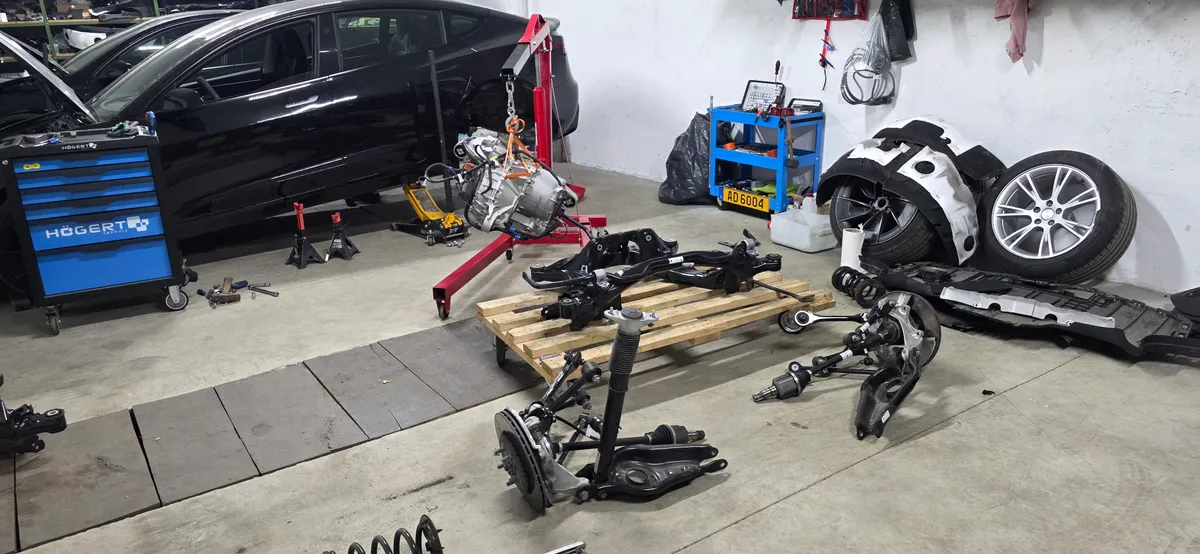
Tesla Tie Rod End Replacement Guide (2026): DIY Steering Repair for Model 3 & Y

🛠️ Tools for this job:
Tesla Model 3/Y Outer Tie Rod End — US
Tesla Model 3/Y Outer Tie Rod End — DE
Tesla Tie Rod Ends (OEM via RR Car Parts)
+9 more tools ↓

Worn tie rod ends are one of the most common steering issues on Tesla Model 3 and Model Y. They cause loose steering feel, uneven tire wear, and sometimes a noticeable clunking when turning. The good news: outer tie rod ends are one of the simpler suspension repairs you can do yourself — and you can save $300–500 versus a shop visit.

Quick-Reference Snapshot

Detail Spec
Difficulty Medium (3/5)
Time per side 1.5–2.5 hours
Both sides 3–4 hours
Outer tie rod end cost $45–90 each
Alignment (mandatory) $80–150
Total DIY savings $200–500 vs. shop
Castle nut torque 180 Nm (133 ft-lb)
Jam nut torque 80 Nm (59 ft-lb)
Lug nut torque 175 Nm (129 ft-lb)
Castle nut P/N 1109263-00-B (new — never reuse)
Models covered Model 3 (2017–2026), Model Y (2020–2026)

Tesla front suspension showing tie rod end connection to steering knuckle The outer tie rod end connects the steering rack to the steering knuckle. When it wears out, you lose precise steering control.

Table of Contents

  1. Symptoms of Worn Tie Rod Ends
  2. Differential Diagnosis: Tie Rod vs. Ball Joint vs. Wheel Bearing
  3. Why Tie Rod Ends Fail
  4. Parts, Pricing & Brand Comparison
  5. OEM Part Numbers & EU Sourcing
  6. 2024+ Model 3 Highland & Model Y Juniper Notes
  7. DIY Replacement Guide
  8. Post-Installation
  9. Wheel Alignment — What the Printout Should Show
  10. Inner Tie Rod Replacement
  11. Cost Comparison
  12. From the Workshop: Real Tesla Tie Rod Repair Cases
  13. Does Tie Rod Wear Affect Tesla Autopilot or FSD?
  14. Pre-Purchase Inspection: Checking Tie Rod Ends on a Used Tesla
  15. Model 3 Performance & AWD Variants: Faster Wear, Earlier Replacement
  16. Salt-Belt Prevention Protocol
  17. What Your Alignment Shop Gets Wrong
  18. Inspection Intervals
  19. Common Mistakes to Avoid
  20. When to Call a Professional
  21. Frequently Asked Questions

Symptoms of Worn Tie Rod Ends

While Driving:

  • Loose or vague steering feel
  • Steering wheel doesn't return to center smoothly
  • Vibration at highway speeds
  • Car wanders or drifts despite proper alignment
  • Squealing sound when turning

Visual Signs:

  • Uneven tire wear (inside or outside edge)
  • Torn or cracked tie rod boot
  • Visible play when grabbing the tire at 3 and 9 o'clock and rocking it

The Shake Test: Lift the front of the car and grab the tire at 3 and 9 o'clock (horizontal). Push and pull. Any clicking or play means your tie rod end or ball joint is worn. To isolate the tie rod, have someone watch the tie rod joint while you rock the wheel. Movement at the boot or the ball socket itself = outer tie rod end. Movement at the inner rack boot = inner tie rod end.

Inner vs. Outer: Outer tie rod ends fail far more often than inner tie rod ends. The outer end has a ball joint exposed to road spray and debris, while the inner is protected by the steering rack boot. This guide covers both — but start with the outer.

Differential Diagnosis: Tie Rod vs. Ball Joint vs. Wheel Bearing

The shake test is the fastest filter, but tie rod wear overlaps with several other front suspension components. This table helps isolate the culprit before ordering parts:

Symptom Outer Tie Rod Lower Ball Joint Wheel Bearing Control Arm Bushing
Play at 3–9 o'clock (horizontal shake) ✓ Strong Possible Possible Rare
Play at 12–6 o'clock (vertical shake) Rare ✓ Strong Possible Possible
Clunk when turning, not only on bumps ✓ Common ✓ Common Rare Rare
Clunk over bumps only, no turning Rare Possible Rare ✓ Common
Humming or grinding at highway speed No No ✓ Directional No
Uneven front tire wear (inner/outer edge) ✓ Yes ✓ Yes No ✓ Yes
Steering wheel shakes at 100–130 km/h Possible Possible ✓ Yes No

The isolation test: With the car on jack stands, have an assistant wiggle the steering wheel slowly left and right while you observe the tie rod joint from below with a light. If the outer ball socket moves before the wheel rotates, the tie rod end is worn. If the wheel turns but the socket moves after a noticeable delay, the issue is in the steering rack or column.

Ball joint vs. tie rod: The Model 3 and Y use a lower ball joint integrated into the control arm. Play at 12–6 o'clock (vertical axis) points to the ball joint — read our control arm replacement guide before ordering tie rod ends.

Wheel bearing: A worn wheel bearing produces a directional hum that changes pitch when you swerve — not a clunk under steering input. If you have noise but no play at either shake test axis, check the bearing first. See our wheel bearing replacement guide for the load test procedure.

Suspension noise overview: If you are unsure which component is at fault, our suspension noise diagnosis guide walks through the full sequence — tie rod, ball joint, bearing, strut mount, and subframe bushing — in a single diagnostic workflow.


Why Tie Rod Ends Fail

  1. Road salt and water — Ball joint boot degrades, water enters the joint and causes corrosion
  2. Potholes and curb hits — Impact loading bends the stud or accelerates wear on the ball socket
  3. Mileage — Normal wear item, typically 80,000–150,000 km depending on roads
  4. Boot damage — Once the rubber boot tears, the joint is on borrowed time (water + grit = fast wear)
  5. Low-quality aftermarket parts — Cheap tie rod ends use inferior steel and grease — they fail in 30,000–50,000 km

Parts, Pricing & Brand Comparison

Part Estimated Cost Notes
Outer tie rod end (each) $45–90 OEM or quality aftermarket
Cotter pin $1–2 Often included with new tie rod end
Wheel alignment $80–150 Required — do not skip

Brand Comparison: Which Tie Rod End Should You Buy?

Brand Quality Price Notes
Tesla OEM (via parts.tesla.com) Excellent $80–120/side Exact fit, warranty preserved, best choice for new vehicles
RR Car Parts OEM Excellent Varies Genuine OEM sourced from Tesla — reliable alternative to service center pricing
Moog (ES800965 / ES800966) Very Good $50–75/side Industry-standard brand, OE-quality materials, widely available
Mevotech Supreme Very Good $45–65/side Good value, greaseable ball joint extends life
Generic / no-name Poor $20–35/side Avoid — pre-loaded play, fail in under 50,000 km

Shop US: Outer tie rod ends on Amazon.com

Shop DE: Spurstangenköpfe auf Amazon.de

Replace in pairs: If one side is worn, the other is likely close behind. Replace both outer tie rod ends at the same time to avoid doing this job twice and paying for two separate alignments.

OEM Part Numbers & EU Sourcing

Tesla OEM Part Numbers

Tesla revises part numbers frequently by "revision letter" (e.g., -00-A → -00-B). Always verify by VIN at parts.tesla.com before ordering — the wrong revision can produce a different taper diameter that won't seat correctly in the steering knuckle.

Component Notes
Outer tie rod end (right) Verify by VIN — revision letter critical
Outer tie rod end (left) Verify by VIN — revision letter critical
Castle nut P/N 1109263-00-B — universal across all Model 3 and Model Y
Inner tie rod end Verify by VIN — rarely replaced, but inspect the boot
Steering rack boot (inner) Inspect while in there — replace if cracked

The one universal part number you can order without VIN lookup is the castle nut (1109263-00-B). It is never reused — order one per side. The cotter pin is typically included with quality aftermarket tie rod ends; if not, a standard M8 cotter pin works.

EU & European Market Sourcing

If you are in Germany, the Netherlands, Lithuania, or elsewhere in the EU, avoid ordering from Tesla Service Center parts counters — markups are significant. These are reliable EU alternatives:

Supplier Market Notes
RR Car Parts EU (Lithuania) Genuine OEM Tesla parts sourced directly — no service center premium
Amazon.de EU/DE Moog, Mevotech, TRW — search Spurstangenkopf Tesla Model 3
Autodoc.eu EU-wide Wide SKU coverage, fast shipping from German/Polish warehouses
KFZ-Teile24 DE Good Moog/TRW coverage, German-language catalog

EU price benchmarks (2026):

  • OEM outer tie rod end via RR Car Parts: €65–120/side
  • Moog/equivalent via Autodoc: €35–65/side
  • 4-wheel alignment at independent shop (Lithuania/Germany): €80–130
  • Castle nut 1109263-00-B: €8–12 each (order two)

German search terms: Spurstangenkopf (outer tie rod end), Innere Spurstange (inner tie rod), Spurstange Kugelkopf, Lenkspurkopf — use these when searching Autodoc or Amazon.de if English searches return no results.


2024+ Model 3 Highland & Model Y Juniper Notes

The 2024+ Model 3 Highland and 2024+ Model Y Juniper share the same outer tie rod end design and procedure as earlier Model 3 and Model Y vehicles. Tesla did not change the steering rack or tie rod geometry significantly with either refresh.

What did change on Highland/Juniper:

  • Front subframe mounting points were revised, but the tie rod attachment at the steering knuckle and steering rack is functionally identical
  • Torque specs are unchanged (180 Nm castle nut, 80 Nm jam nut)
  • Some Highland/Juniper models use a slightly revised steering rack boot design — inspect it while you're in there; if torn, replace it

How to verify the correct part for your VIN:

  1. Go to parts.tesla.com and enter your VIN
  2. Navigate to Steering → Tie Rod
  3. Cross-reference the part number before ordering aftermarket
VIN Decoder Tip: If you're using an aftermarket supplier, filter specifically by model year. "Model 3 2024" Highland parts don't always appear in older search filters — always confirm by VIN.

DIY Replacement Guide

Tools Required

  • Floor jack (3+ ton) — US | DE
  • Jack stands
  • 22mm deep socket (castle nut)
  • 21mm combination wrench (jam nut)
  • 14mm combination wrench (hold tie rod body)
  • Ball joint separator (fork type or screw type) — US | DE
  • Torque wrench (capable of 80 Nm and 200 Nm) — US | DE
  • White paint marker or correction fluid — US
  • Penetrating oil (PB Blaster or Wurth Rost-Off)
  • Needle-nose pliers (for cotter pin)
  • 10mm 12-point combination wrench (to hold stud from spinning)

Step 1: Preparation (10 min)

  1. Park on level, solid ground
  2. Loosen front lug nuts slightly (one full turn — don't remove yet)
  3. Lift the front with floor jack at the proper Tesla jack point
  4. Secure on jack stands under the frame rails
  5. Remove the front wheel
  6. Spray the castle nut, jam nut, and tie rod threads with penetrating oil — let it soak while you gather tools

Step 2: Mark the Position (5 min)

This is the most important step for getting your alignment close enough to drive to the shop safely.

  1. Use a paint marker to make alignment marks across the jam nut and tie rod body
  2. Count and record the exact number of exposed threads between the jam nut and the tie rod end — write it down
  3. Take a clear photo from two angles for reference
Why this matters: The position of the tie rod end on the tie rod controls your toe angle. Getting it back to the same position means your alignment will be close enough to drive safely to the alignment shop — typically within 5 km. Off by even 1–2 turns and your tires will scrub and the car will pull hard.

Step 3: Remove the Old Tie Rod End (20–40 min)

  1. Remove the cotter pin from the castle nut using needle-nose pliers — open and pull, don't just try to yank
  2. Remove the castle nut (22mm) from the tie rod end stud — hold the stud flat with a 10mm wrench if it spins
  3. Use a ball joint separator to pop the tie rod end out of the steering knuckle
    • Position the separator fork between the knuckle and the tie rod end base
    • Tighten the screw or strike the fork until the taper breaks free with a sharp pop
    • Do NOT hammer the stud directly — this damages the steering knuckle bore
Seized nuts: If the jam nut won't move even after penetrating oil, apply heat with a torch (propane is fine) carefully around the nut — avoid the boot. Then try again. Do not apply heat near the CV axle or ABS lines.
  1. Loosen the jam nut (21mm) while holding the tie rod body with a 14mm wrench
  2. Unscrew the tie rod end from the tie rod — count every turn as you go
  3. Compare your count to your reference number from Step 2

Step 4: Install the New Tie Rod End (15 min)

  1. Thread the new tie rod end onto the tie rod exactly the same number of turns as you removed
  2. Align to your paint marks
  3. Verify thread engagement — at minimum 8 threads fully engaged with the jam nut range
  4. Insert the stud into the steering knuckle taper
  5. Hand-thread the new castle nut (do not reuse the old one — use P/N 1109263-00-B)

Step 5: Torque to Specification (10 min)

Torque Values (Model 3 / Model Y — verified against Tesla Service Manual, March 2026):

  • Tie rod end nut (castle nut to knuckle): 180 Nm (133 ft-lb)
  • Jam nut (outer tie rod to inner tie rod): 80 Nm (59 ft-lb)

Tightening Procedure:

  1. Torque the castle nut to 180 Nm
  2. If the cotter pin hole doesn't align, tighten further only (never loosen to align)
  3. Install new cotter pin through the hole and castle nut slots — bend both legs in opposite directions
  4. Torque the jam nut to 80 Nm against the tie rod body
  5. Confirm paint marks are aligned within reason

Step 6: Reassemble (10 min)

  1. Reinstall the wheel
  2. Hand-tighten lug nuts in a cross/star pattern
  3. Lower the car off jack stands
  4. Torque lug nuts to 175 Nm (129 ft-lb) in a star pattern

Step 7: Repeat for the Other Side

Mirror the procedure on the opposite side. Both sides done at once = one alignment visit, not two.


Post-Installation

Wheel Alignment — Mandatory

Do not skip this. Even if you matched the marks perfectly, the new tie rod end may have slightly different geometry.

  • Drive carefully and directly to the alignment shop — keep under 15 km
  • Expect to pay $80–150
  • Request a full 4-wheel alignment printout
  • Keep the printout to compare at your next oil/tire service

Test Drive Checklist

After alignment:

  • [ ] Steering wheel centered while driving straight
  • [ ] No play or looseness in steering feel
  • [ ] No clunks or pops when turning
  • [ ] Car tracks straight on a flat, level road
  • [ ] No vibration at highway speed (80+ km/h)
  • [ ] Check alignment again after 500 km — confirm nothing shifted

See our wheel alignment guide for more details on what to expect.


Wheel Alignment — What the Printout Should Show

After tie rod end replacement, the alignment shop will adjust toe. Here are the factory Tesla front toe specs so you can verify the printout:

Measurement Model 3 Target Model Y Target Acceptable Range
Front toe (per side) 0° ± 0.10° 0° ± 0.10° −0.10° to +0.10°
Front total toe 0° ± 0.20° 0° ± 0.20° −0.20° to +0.20°
Front camber −0.50° ± 0.50° −0.50° ± 0.50° −1.0° to 0°
Rear toe +0.15° ± 0.15° +0.15° ± 0.15° 0° to +0.30°
Ask for a before/after printout. The "before" reading will show exactly how far your toe drifted when you matched the marks. Most DIYers get within 0.10–0.20° — good enough to drive, not good enough to leave without correction.

If your printout shows front toe outside ±0.20° despite the alignment adjustment, check that the jam nut is fully torqued and the tie rod end seated properly in the knuckle taper.


Inner Tie Rod Replacement

Inner tie rod ends fail less frequently than outer ends, but when they do, the steering feel becomes particularly vague and imprecise — not just loose, but disconnected.

Signs of a failed inner tie rod:

  • Play felt at the center of the tie rod (not the outer ball joint)
  • Torn or cracked inner rack boot (water entry accelerates wear)
  • Movement visible at the rubber bellows boot when someone rocks the wheel
  • Failed play test at the rack boot area specifically

What's different from outer tie rod replacement:

Factor Outer Tie Rod Inner Tie Rod
Access Easy Requires removing outer tie rod and rack boot
Special tool needed Ball joint separator Inner tie rod removal tool (crowfoot-style)
Torque spec 180 Nm (castle nut) ~150 Nm (threaded into rack — verify by model year)
Difficulty Medium Hard
DIY time 1.5–2 hours/side 2.5–3.5 hours/side

Inner Tie Rod DIY Steps (Overview)

  1. Remove the outer tie rod end (follow Steps 1–3 above)
  2. Slide the inner rack boot back to expose the inner tie rod thread
  3. Use a dedicated inner tie rod removal tool — US | DE — these engage the wrench flats on the inner tie rod body
  4. Counter-hold the steering rack with a second wrench to prevent rack rotation (critical — rotating the rack can damage the rack seals)
  5. Thread in the new inner tie rod to specification (typically 100–150 Nm — verify your exact model year in the service manual)
  6. Slide the rack boot back and secure with the boot clamps
  7. Reinstall the outer tie rod end with the same marks and thread count
  8. Get a wheel alignment immediately
Do NOT try to use a standard wrench on inner tie rod flats without the proper removal tool. The access angle is poor and the torque required is high. Without the tool you'll round the flats or damage the rack boot. The inner tie rod removal tool is a one-time $25–40 investment that makes this job safe. See our suspension noise diagnosis guide to confirm which component is actually failing before you start.

Cost Comparison

Option Parts (both sides) Labor Alignment Total
Tesla Service Center $200–300 $300–500 Included $500–800
Independent Shop $150–250 $150–300 $80–150 $380–700
DIY (OEM Parts) $150–250 Free $80–150 $230–400
DIY (Aftermarket) $80–160 Free $80–150 $160–310

From the Workshop: Real Tesla Tie Rod Repair Cases

These cases come from RR Car Parts workshop in Kaunas, Lithuania and the Tesla DIY community across Europe. All prices are in euros (EU market).


Case 1 — 2019 Model 3 Long Range, 94,000 km, Kaunas, Lithuania

Symptom: Owner described steering as "heavy and disconnected" at motorway speed. Left outer tie rod end failed the horizontal shake test with 5 mm of play at the ball socket. Inner rods tested fine.

Repair: Both outer tie rod ends replaced with OEM parts via RR Car Parts (€89/side). Castle nut 1109263-00-B × 2. 4-wheel alignment at local independent shop.

Total cost: €178 parts + €25 labor + €95 alignment = €298 vs. Tesla SC estimate of €810.

Notes: The failed boot was cracked on the inside where road salt had been pooling — invisible from above during a visual inspection. Standard practice in northern EU is to apply Würth Rost-Off Plus or similar cavity wax to exposed steering joints after any suspension work.


Case 2 — 2021 Model Y Long Range AWD, 76,000 km, Berlin

Symptom: Autopilot lane-keep assist making unexplained small steering corrections on straight Autobahn sections. Owner suspected FSD calibration issue. Inspection found the outer right tie rod end with measurable play and a cracked boot — root cause was micro-jitter in the steering column that Autopilot's torque sensor was detecting and overcorrecting.

Repair: Right outer tie rod end replaced with Moog-equivalent via Amazon.de (€54). Single-side alignment adjusted toe by +0.13°.

Total cost: €54 part + €105 alignment = €159 vs. €640 at Tesla SC.

Notes: The phantom Autopilot corrections disappeared after alignment. Camera recalibration was triggered via Controls → Service → Camera Calibration after the repair. FSD behaved normally within 100 km of recalibration. A worn tie rod is a plausible cause of unexplained ADAS behavior — check it before assuming a software issue.


Case 3 — 2022 Model 3 Performance, 61,000 km, Amsterdam

Symptom: Accelerated outer edge wear on both front tires despite alignment done 8 months prior. Both outer tie rod ends had slight but consistent play — not severe enough to clunk, but enough to allow toe drift.

Repair: Both sides replaced simultaneously with OEM parts (€108/side). Single alignment visit.

Total cost: €216 parts + €110 alignment = €326 vs. €780 Tesla SC estimate.

Notes: Performance model on 20" Überturbine wheels. Wide-tread performance tires amplify geometry sensitivity — even 0.10° of toe-out becomes visible in wear pattern within 8,000–10,000 km. Owner now inspects tie rod ends every 20,000 km.


Case 5 — 2022 Model Y Long Range AWD, 88,000 km, Oslo, Norway

Symptom: Owner noticed the steering felt progressively more vague at motorway speeds over a 6-month period. Norwegian winters (10 months of salt exposure) had destroyed both outer tie rod end boots — visible grease streaking outward from both joints. Both outer ends failed the shake test with 4–6 mm of play.

Repair: Both outer tie rod ends replaced with Moog-equivalent sourced via Autodoc.eu (€48/side, delivered to Oslo in 3 days). Castle nuts × 2. Full 4-wheel alignment at an independent VAG/EV specialist in Oslo.

Total cost: NOK 1,250 parts (~€110) + NOK 1,800 alignment (~€160) = NOK 3,050 (~€270) vs. Tesla SC estimate of NOK 12,400 (~€1,100).

Notes: Norway has the highest Tesla density per capita in Europe and among the most aggressive road-salting programs in Scandinavia. At 88,000 km, the boots were already splitting at the base seal — not the typical upper cracking. The mechanic applied Dinol ML Anti-corrosion Wax to the entire front steering assembly post-repair. Norwegian owners: inspect tie rod boots annually, not just at scheduled service intervals.


Case 6 — 2021 Model 3 Long Range, 103,000 km, Helsinki, Finland

Symptom: Left outer tie rod end with significant play (8 mm at the tire rim edge). Owner had done their own alignment tape-measure check after noticing tire wear and booked the repair proactively — before any audible clunking appeared.

Repair: Both outer tie rod ends replaced with OEM-spec parts via RR Car Parts (€95/side). Wheel alignment at a Bosch Car Service partner in Helsinki.

Total cost: €190 parts + €30 labor + €115 alignment = €335 vs. Tesla SC Helsinki estimate of €920.

Notes: Finland's freeze-thaw cycle (the freeze-thaw mechanism is particularly destructive because water expands in the boot seal and causes micro-tears) creates unusually rapid boot degradation. The mechanic found one cotter pin had been replaced with a standard bolt at a previous service — wrong repair, creates binding that accelerates taper wear. Always use the correct cotter pin and inspect what was done in previous repairs if buying used.


Case 4 — 2020 Model Y Standard Range+, 112,000 km, Vilnius

Symptom: High-mileage vehicle with both outer tie rod ends worn through and the inner right tie rod also showing movement at the rack boot.

Repair: All four components replaced: both outer + right inner tie rod. The inner required an OTC inner tie rod removal tool (€38, one-time purchase). Full 4-wheel alignment. Rack boot also replaced (€22) — was showing early cracking.

Total cost: €450 parts + €35 labor + €110 alignment = €595 vs. €1,450+ Tesla SC estimate for equivalent work.

Notes: At 112,000 km in a salt-exposed market, a full front steering refresh makes economic sense as a single job. Doing inner and outer together means one alignment, one labor session, and knowing the steering geometry is completely fresh.


Does Tie Rod Wear Affect Tesla Autopilot or FSD?

Yes — and this connection surprises many owners. Here's how worn tie rod ends interact with Tesla's ADAS systems:

Autopilot lane-keep phantom corrections: Autopilot reads the steering column torque sensor continuously. A worn outer tie rod end introduces micro-play between the rack and steering knuckle. As the system tracks lane lines and applies micro-corrections, it detects unexpected mechanical compliance — the steering "gives" slightly under load. The algorithm interprets this as lane drift and applies additional correction, producing the characteristic small steering adjustments on a straight road.

FSD calibration drift: Tesla FSD calibration maps steering angle sensor data to camera feeds. Significant toe change from a worn tie rod (0.20°+ from spec) shifts how camera inputs map to steering outputs, causing calibration to drift over time. Symptoms include AutoSteer deviating from the center of lanes, phantom braking on curves, or FSD disengaging with "take over immediately" warnings.

What to do after tie rod replacement:

  1. Get a 4-wheel alignment first (before any recalibration)
  2. Drive 15–30 minutes on well-marked roads with Autopilot off
  3. Trigger camera recalibration: Controls → Service → Camera Calibration → Clear Calibration
  4. Allow 20–50 km for calibration to complete (display shows remaining distance)

Safety note: If your car is in supervised Autopilot or FSD Beta and a tie rod end fails mechanically under load, the system cannot compensate — there is no redundant steering actuator. Tie rod separation at highway speed means immediate loss of steering control. This is not a theoretical scenario: ball socket fracture under high lateral load (emergency lane change, pothole at speed) is the failure mode. Inspect and replace worn tie rod ends before they reach that point.


Pre-Purchase Inspection: Checking Tie Rod Ends on a Used Tesla

Buying a used Tesla without inspecting the front steering geometry is one of the most common expensive mistakes in the second-hand EV market. Worn tie rod ends on a used car mean an immediate repair bill of $160–310 DIY or $500–800 at a service center — a solid negotiating tool if you know what to look for.

The 4-Minute Pre-Purchase Tie Rod Check

Step 1 — Visual inspection (1 minute): Crouch in front of the car and look along the tie rod from the wheel side. You're looking for:

  • Torn, cracked, or missing rubber boot (boot holds grease in the joint — any crack means water intrusion)
  • Grease streaking outward from the boot toward the wheel (centrifugal sling pattern — joint has been spinning with a damaged boot)
  • Corrosion or rust on the outer tie rod body itself (surface rust is normal; pitting or scale is not)
  • Bent tie rod body (indicates a previous impact — ball socket may be damaged even if the test shows acceptable play)

Step 2 — Shake test (2 minutes): With the car on level ground, grab the front tire at 3 and 9 o'clock (not 12 and 6 — that tests ball joints). Push and pull firmly with both hands. Any clicking, clunking, or visible movement at the tie rod joint ball socket means the tie rod end is worn and needs replacement before you drive this car.

For a cleaner test: have the seller start the engine with the steering unlocked, then have them hold the wheel while you watch the tie rod joints from below as they gently wiggle it side to side. Movement visible at the boot or socket before the wheel turns = worn tie rod.

Step 3 — Check the tire wear pattern (1 minute): Inner edge wear on front tires + visual play at the tie rod = tied pair. This combination almost always means the car has been driven with misalignment from worn tie rod ends for many months — tire replacement may also be needed.

Using Tie Rod Condition in Price Negotiation

If you find a worn tie rod end during pre-purchase inspection:

  • DIY cost to fix: $160–310 (both sides + alignment, aftermarket parts)
  • Independent shop cost: $380–700
  • Tesla Service Center cost: $500–800

Ask for the independent shop cost as a deduction from the purchase price — it's reasonable and specific. Sellers who balk at this deduction typically know the car has issues. See our used Tesla buying inspection guide for the full 45-point pre-purchase checklist.


Model 3 Performance & AWD Variants: Faster Wear, Earlier Replacement

The Model 3 Performance and any AWD Tesla deserve specific attention when it comes to tie rod end lifespan.

Why Performance Models Wear Tie Rod Ends Faster

Factor Standard RWD Long Range AWD Performance
Front axle load Lower Higher (front motor) Higher (front motor)
Wheel width 235mm 235mm 235–245mm
Wheel diameter 18–19" 18–19" 20" (Überturbine)
Track width Stock Stock +5mm wider
Steering lateral load Baseline +12–18% +25–35%
Expected tie rod interval 100,000–150,000 km 80,000–120,000 km 60,000–100,000 km

Three reasons Performance models wear tie rods faster:

  1. Wider, heavier wheels. The 20" Überturbine wheels on Performance models are wider and heavier than 18" or 19" aero wheels. More unsprung weight = higher lateral forces on the tie rod joint under cornering.

  2. Performance driving profile. Not everyone drives a Performance model gently. High-speed lane changes, track days, and aggressive cornering produce lateral loads that wear the ball socket faster than typical commuter use.

  3. Alignment sensitivity. The Performance model runs a slightly more aggressive factory toe setting — even small deviations from spec produce visible tire wear faster, which often brings owners in for alignment checks where tie rod wear is discovered earlier.

Practical Recommendation for Performance Owners

Inspect tie rod ends every 15,000 km. At 60,000 km, have a specialist perform the isolation shake test — not just the visual boot check. Pre-emptively replacing tie rod ends at 80,000 km on a Performance model costs $160–310 DIY; waiting for failure at a bad time on the Autobahn costs more than money.

If you are on track days: inspect tie rod ends before and after every track day. The lateral loads from repeated autocross or circuit cornering can accelerate boot cracking even on low-mileage cars.


Salt-Belt Prevention Protocol

For Tesla owners in northern US states, Canada, Scandinavia, Finland, the UK, and northern Germany: salt-road corrosion is the primary cause of premature tie rod end failure — not mileage. A boot crack at 40,000 km in Oslo does more damage than 100,000 km of dry-road driving in Arizona.

Prevention Schedule

Interval Action
Every 15,000 km or every autumn Inspect tie rod boots for cracks, swelling, or grease weeping
After any curb strike or pothole impact Immediate visual inspection and shake test
Annual (before salt season) Apply cavity wax or tie-rod boot spray to exposed steering joints
At any suspension work Replace boots proactively if over 60,000 km old, regardless of appearance

Recommended Products (2026)

Boot preservation (apply annually before winter):

  • Würth Rost-Off Plus — cavity wax spray, penetrates boot base seal — Amazon.de
  • Dinol ML Anti-corrosion — wax-based, used by Scandinavian fleet operators — Amazon.de
  • Fluid Film (NLGI-0 lanolin wax) — US market standard for tie rod and ball joint boot preservation — Amazon.com

Early boot replacement: If a boot shows any cracking but the joint still passes the shake test, replace just the boot — not the entire tie rod end. A boot kit costs $8–15 and takes 20 minutes if you're already doing other front suspension work. Waiting until the joint itself fails turns an $8 repair into a $160+ repair.

Note: Tie rod end boots are not greaseable on most Tesla Model 3/Y applications — there is no grease fitting. The factory grease is sealed inside for life. Once the boot tears, the original grease sheds within 2,000–5,000 km of wet road driving and the joint runs dry.


What Your Alignment Shop Gets Wrong

After replacing tie rod ends, most owners head to the nearest alignment shop and assume the job is complete. In practice, three common alignment shop errors can undo a perfect tie rod replacement:

1. Adjusting toe only — not checking caster or camber

Tie rod end replacement changes toe directly, but worn tie rod ends often develop alongside worn control arm bushings that affect camber. A shop that adjusts toe to spec without checking camber and caster is giving you a partial alignment. Request a 4-wheel thrust-line alignment — this measures all angles and aligns the rear axle thrust line with the front steering axis. Cost: $10–30 more than a basic front-only alignment.

2. Not providing a before/after printout

Always ask: "Can I see the before and after printout?" A shop that refuses or says "we don't do that" should raise a flag. The before reading confirms your tie rod marks were close — most DIYers are within 0.10–0.20°. The after reading confirms everything is in spec. Keep the printout in your glove box for comparison at the next suspension service.

3. Aligning before torquing the jam nut

This sounds basic but it happens: a shop performs the alignment with the tie rod end in position but before the jam nut is fully torqued. The alignment looks correct on the printout. Three months later, the jam nut (which wasn't tight) allows the tie rod end to rotate slightly under load — your toe drifts and your tires start wearing. Before driving away from any alignment, confirm the jam nut is torqued to 80 Nm and the castle nut cotter pin is installed.

4. Running a front-only alignment after both sides

If you replaced both outer tie rod ends, request a 4-wheel alignment — not just front. Even if the rear was fine before, the thrust line measurement ensures the rear axle is parallel to the front steering. This is critical for straight tracking on the highway.


Inspection Intervals

Mileage / Trigger Action
Every 20,000 km or at tire rotation Boot visual check + horizontal shake test (both front wheels)
Every 15,000 km (salt-belt climates) Same as above, plus inspect for grease weeping from boot base
Every 40,000 km Full steering geometry check — have a shop confirm tie rod end, ball joint, and wheel bearing play
After any curb strike or major pothole Immediate shake test; if any play found, do not drive — inspect and replace
At 60,000 km (Performance / AWD models) Proactive replacement consideration — joints exposed to higher lateral loads
Pre-purchase inspection (used Tesla) Full boot inspection + shake test before committing to purchase
After suspension work (struts, control arms) Always replace tie rod ends and get a 4-wheel alignment in the same session

If you are managing maintenance across a fleet of Teslas or are building a scheduled DIY maintenance workflow, our Tesla maintenance schedule guide includes the full inspection cadence for all wear components, including tie rods, ball joints, wheel bearings, and struts.


Common Mistakes to Avoid

  1. Not marking the position — You'll have no alignment reference and risk destroying tires or pulling hard on the way to the shop
  2. Hammering the stud — Damages the knuckle bore. Always use a ball joint separator.
  3. Reusing the castle nut — Always use a new one. Castle nuts are torque-to-yield or deform during installation.
  4. Reusing the cotter pin — Single-use item. New one costs $1.
  5. Skipping alignment — Even "perfect" mark matching needs verified with equipment
  6. Only replacing one side — The other side is almost as worn — you'll be back doing this in 6 months
  7. Forgetting to torque the jam nut — The tie rod end will rotate under load, your toe will drift, and you'll have handling issues without warning
  8. Over-tightening the castle nut to align the cotter pin hole — You can advance past the hole to align it, but never back off the nut

When to Call a Professional

  • Castle nut or jam nut is severely corroded and won't move even with heat and penetrating oil
  • You find play in the inner tie rod end too (requires special tools and more precision)
  • The steering knuckle taper bore shows damage (scoring, elongation)
  • The steering rack boot is torn and shows signs of rack damage (unusual fluid, excessive play)
  • You're not comfortable working under the car or setting torque accurately

Frequently Asked Questions

How much does Tesla tie rod end replacement cost? DIY with quality aftermarket parts runs $160–310 total (parts both sides + alignment). A Tesla Service Center charges $500–800 all-in. The repair itself is Medium difficulty — comparable to brake pad replacement.

Can I drive with a bad tie rod end? No. A tie rod end with significant play can separate from the steering knuckle while driving, causing complete loss of steering control. If you've confirmed play at the tie rod joint during the shake test, do not drive the car. Either repair it immediately or have it towed.

How long do tie rod ends last? Typically 80,000–150,000 km depending on road conditions, climate (road salt accelerates boot degradation), and driving style. Tesla Model 3 and Y owners in northern Europe or northern North America tend to see failures at the lower end of that range due to salt exposure.

Will Model Y Juniper (2024+) tie rod ends fit a pre-2024 Model Y? The outer tie rod end design is functionally identical across all Model Y production years. However, internal part numbers may differ slightly — always verify by VIN before ordering, especially if buying OEM from Tesla.

Does tie rod end replacement affect the warranty? Replacing a wear item like a tie rod end does not void your Tesla warranty on other systems. However, if the vehicle is still under the basic 4-year/80,000 km bumper-to-bumper warranty and the tie rod failed due to a defect (not wear), Tesla should cover it — schedule a service appointment and request inspection first.

Will worn tie rod ends affect Tesla Autopilot or FSD? Yes. A worn outer tie rod end introduces micro-play in the steering that Autopilot's torque sensor detects as unexpected compliance. This causes the lane-keep algorithm to apply phantom corrections — small unexplained steering movements on straight roads. After replacing tie rod ends and completing wheel alignment, trigger camera recalibration: Controls → Service → Camera Calibration → Clear Calibration. Allow 20–50 km of driving for the system to recalibrate. If you have been noticing FSD or Autopilot behaving strangely, check the tie rod ends before assuming a software problem.

What are the Tesla Model 3 outer tie rod end part numbers? Tesla updates outer tie rod part numbers by revision letter — always verify the correct revision by VIN at parts.tesla.com before ordering. The one universal part you can order without VIN lookup is the castle nut: P/N 1109263-00-B, which is the same across all Model 3 and Model Y. For US aftermarket, Moog ES800965 (right) and ES800966 (left) are the most widely used equivalents for Model 3. For EU buyers: check RR Car Parts or Autodoc.eu — both carry EU-market OEM-spec parts without service center pricing.

Should I replace tie rod ends when doing a front suspension refresh? Yes. If you are already replacing struts, control arms, or sway bar links, add tie rod ends to the job. The incremental labor is 30–45 minutes since the wheel is already off and you are already paying for an alignment. All front suspension work on the same axle requires one alignment visit — combining everything saves $80–150 in duplicate alignment costs and means you know the entire front steering geometry is fresh.


Tie rod end replacement is a straightforward repair that most DIYers can handle in 1.5–2 hours per side. The hardest part is honestly getting to the alignment shop afterward. Mark your positions carefully, torque everything to spec, use a new castle nut and cotter pin, and don't skip that alignment.


Related Guides

Tesla repair workshop

About the Author

Written by an independent, self-taught Tesla mechanic working on Teslas since 2018. I run my own shop and work on Teslas every day. These guides are based on real repair experience — not theory.

More about this site →

🛠️ Tools Needed for This Repair

These are the tools I personally use and recommend. Using quality tools makes the job easier and safer.

We earn commissions from qualifying purchases through our affiliate partners. This helps support the site at no extra cost to you.

Found This Guide Helpful?

Get more Tesla repair tips and new guides delivered to your inbox.

More Repair Guides

Tesla Frunk Won't Open? Emergency Release Guide

Tesla frunk stuck closed? Learn emergency release methods and DIY fixes. Covers latch issues, 12V battery problems, and manual override.

Tesla Suspension Noise: Diagnose & Fix at Home

Tesla suspension making noise? Diagnose clunks, squeaks, and rattles yourself. Covers common causes and DIY fixes before service visits.

Tesla Charge Port Stuck? 6 Ways to Release It (2026)

Tesla charge port won't release the cable? 6 proven methods to unlock a stuck charge port, including manual release, latch replacement, and cold weather fixes for all Tesla models.