Tesla Pyrofuse Explained: What It Does, When It Blows & What to Do
There's a small explosive device inside your Tesla's battery pack, and it might save your life one day.
The pyrotechnic fuse (pyrofuse) is one of the most critical safety components in any Tesla. Most owners will never think about it — until they see a "Battery Fuse requires replacement soon" alert on their screen, or worse, their car goes completely dead after a collision.
This guide covers everything you need to know: what the pyrofuse does, where it's located, what happens when it blows, how much replacement costs, and why this is one repair you should never attempt yourself.
What Is a Tesla Pyrofuse?
A pyrofuse is a pyrotechnic battery disconnect device — essentially a fuse with a built-in explosive charge. Unlike a regular fuse that melts to break a circuit, the pyrofuse uses a small pyrotechnic charge to physically sever the high-voltage connection between the battery pack and the rest of the vehicle.
Key specs:
- Rating: Approximately 2,000 amps
- Trigger: Crash sensors detect a severe impact → airbag control module fires the pyrofuse
- Speed: Disconnects in milliseconds
- Purpose: Isolates 400V+ battery from the vehicle to prevent electrical fire and shock
- Type: Modern versions are "current-powered" (self-powered) — older versions were battery-powered
Think of it as the last line of defense. In a serious crash, the pyrofuse fires and instantly cuts all high-voltage power. First responders can then work on the vehicle without risk of electrocution.
Where Is the Pyrofuse Located?
The location varies by model and battery version:
Model 3 & Model Y
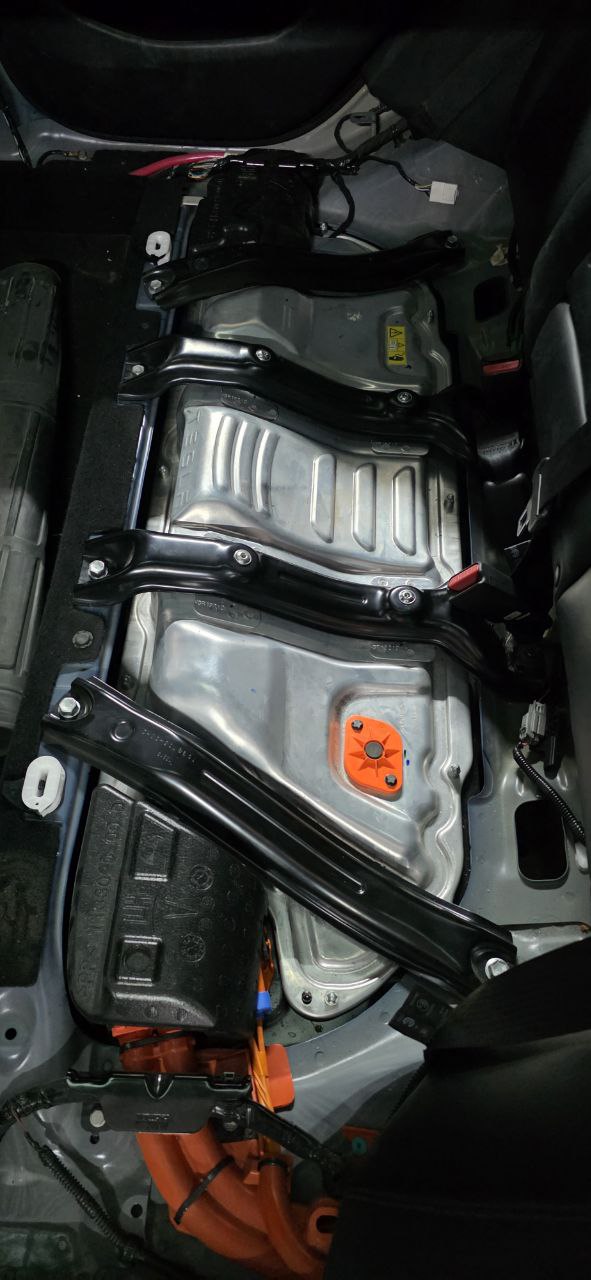
The pyrofuse is located in the battery penthouse — the top section of the HV battery pack accessible from inside the cabin by removing the rear bench seat. It sits in the same compartment as the BMS (Battery Management System). No need to drop the battery pack — you remove the rear seat, then the penthouse service cover to access the fuse.
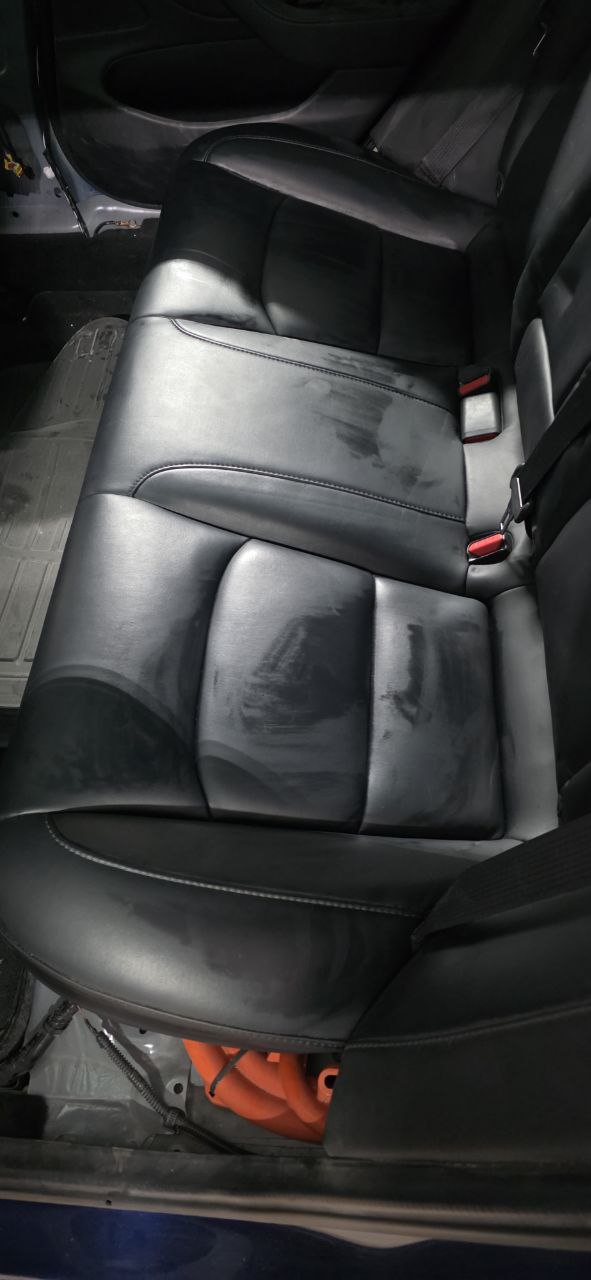
Here's what the process looks like on a real Model 3 (photos from our repair shop):
Step 1: Lift the rear bench seat — you can see the orange HV components peeking through underneath.
Step 2: Remove the seat to expose the penthouse cover — the metal shield protecting the HV battery top. Notice the orange pyrofuse access cap.
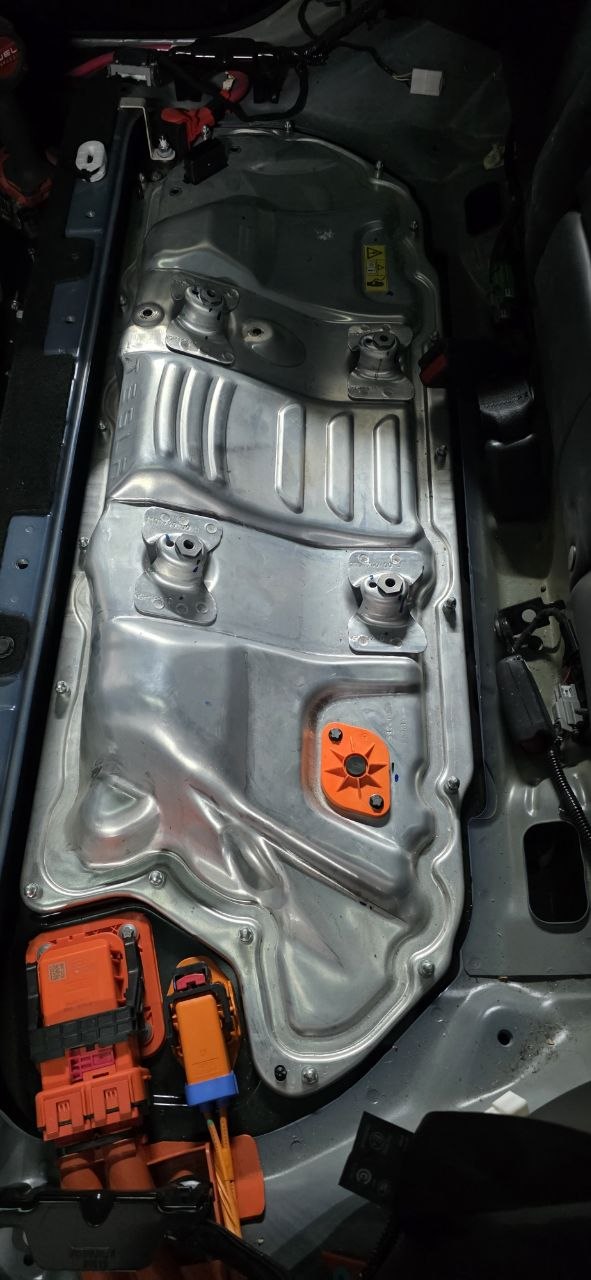
Step 3: Remove the penthouse cover — this reveals the HV components: orange HV connectors, BMS, wiring harness, and the pyrofuse area.
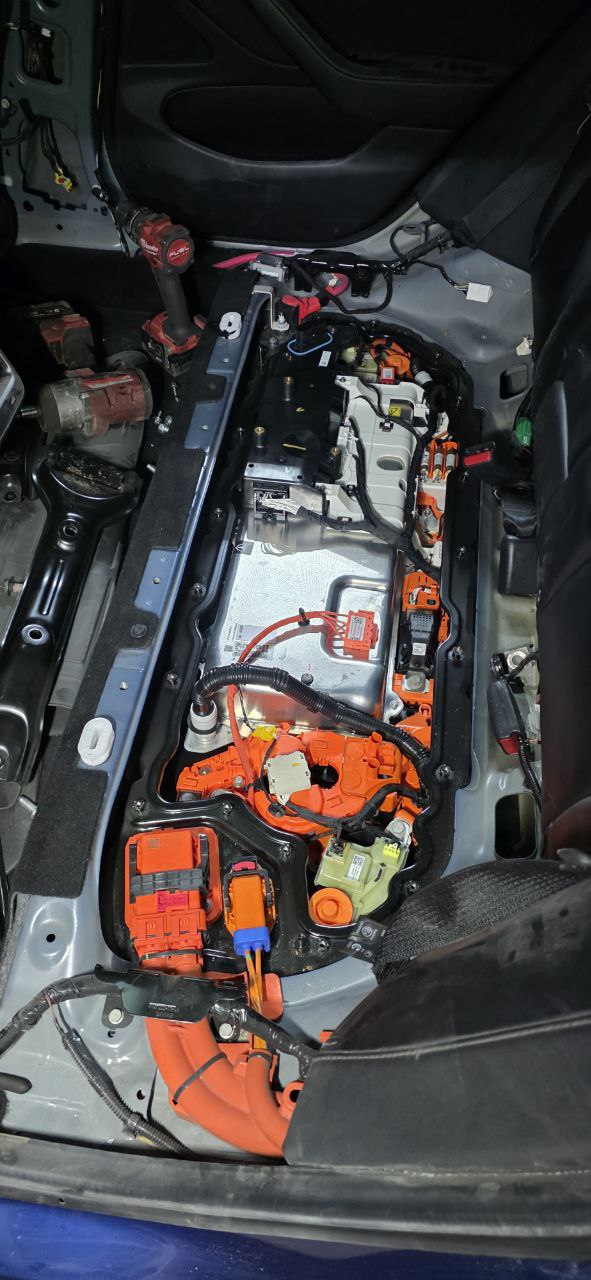
Step 4: Identify the pyrofuse and BMS — the orange component with the QR code label is the pyrofuse disconnect. Note the HV busbars and connectors surrounding it.
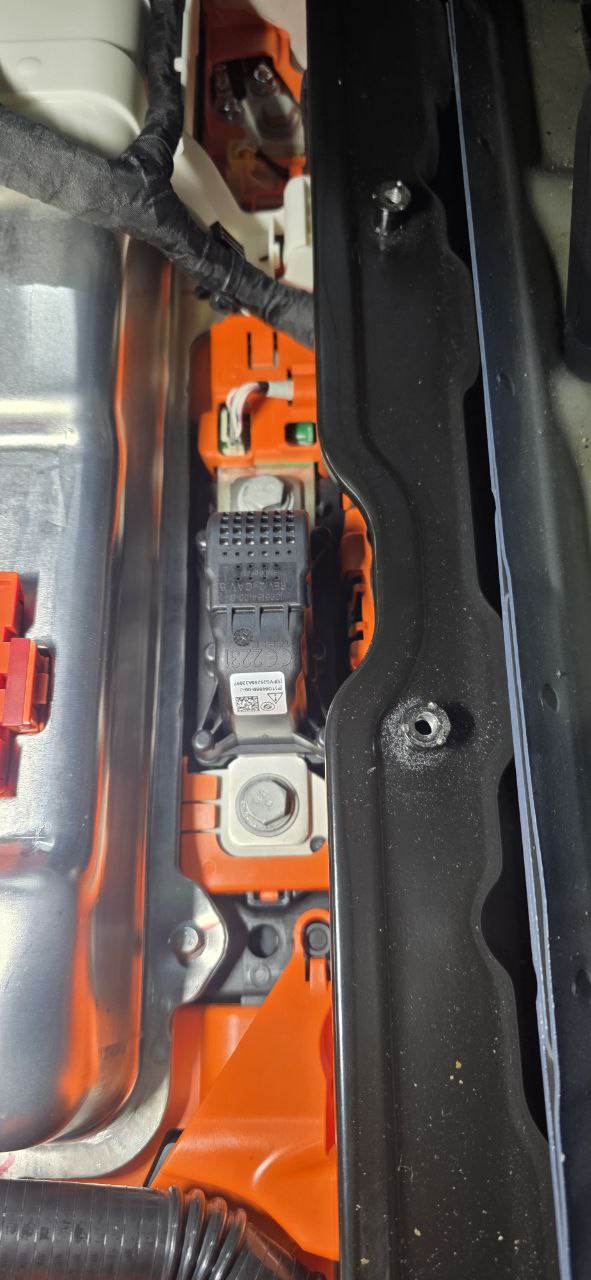
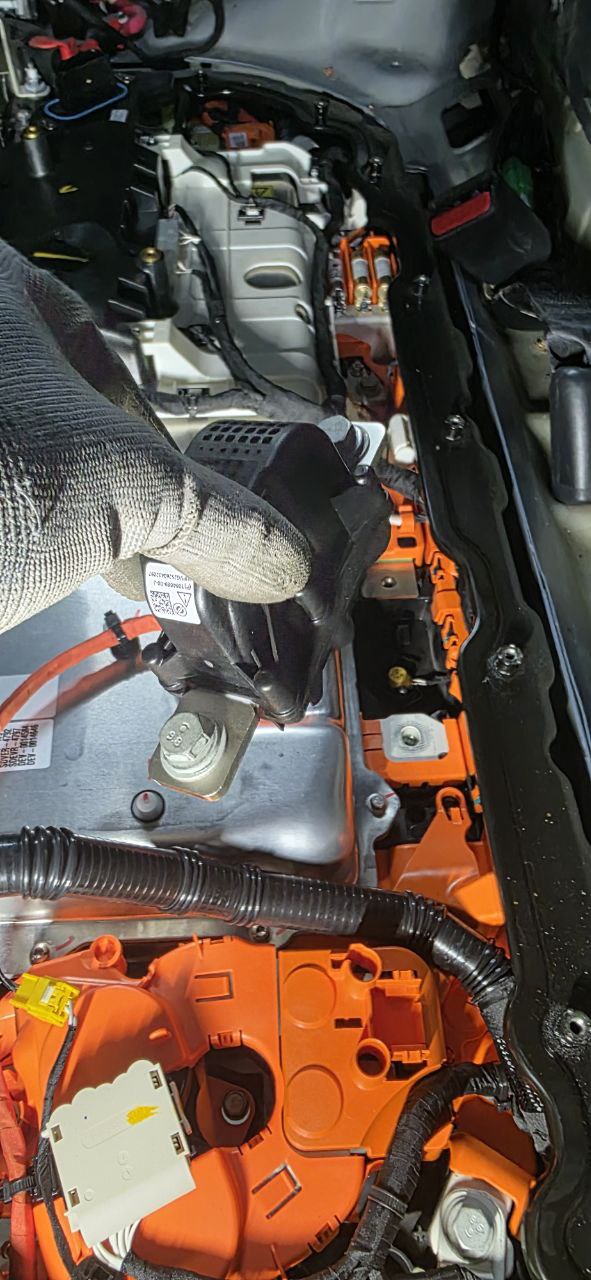
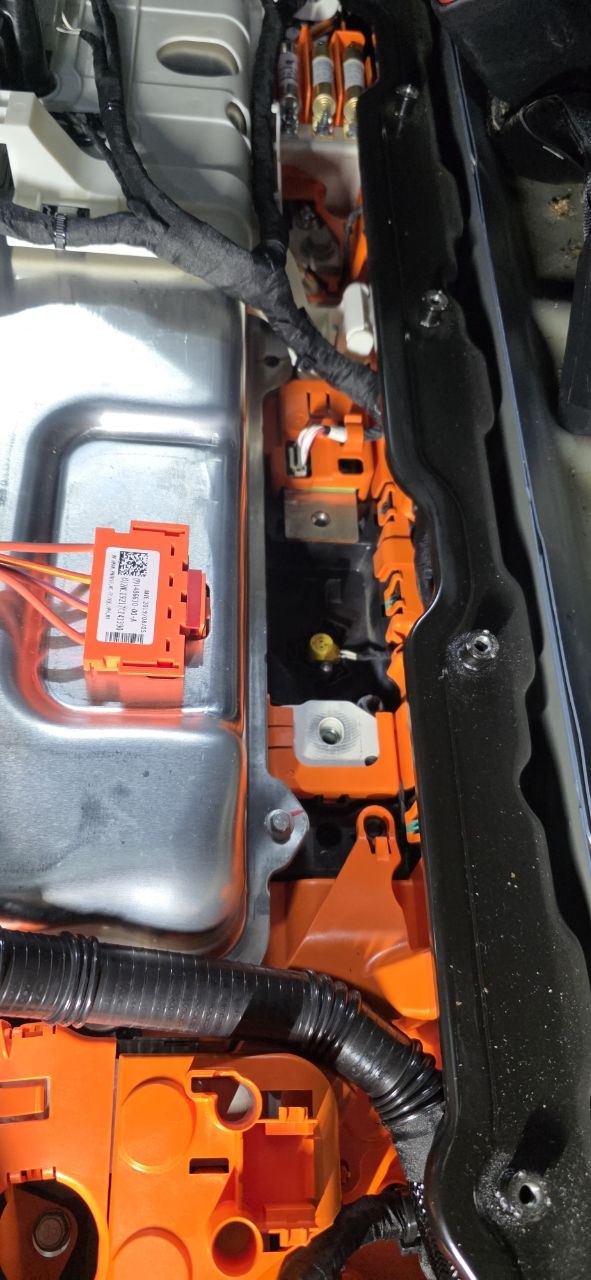
Notice the HV-rated gloves in the photos — this is mandatory PPE when working anywhere near these components.
Model S & Model X
| Battery Version | Location | Access |
|---|---|---|
| Battery 1.0/1.5 (older) | On top of the HV battery | Entire battery pack must be dropped — expensive |
| Battery 2.0 (newer) | Underneath the HV battery | Accessible from below on a lift |
Cybertruck
Similar to Model 3/Y — underneath the battery with a dedicated pyro access cover.
What Causes the Pyrofuse to Blow?
1. Collision (designed behavior)
This is the primary purpose. When crash sensors detect a severe impact, the airbag control module sends a signal to fire the pyrofuse. Even a moderate rear-end collision can trigger it.
Important: The pyrofuse doesn't always blow in every accident. Minor fender benders typically won't trigger it — the impact needs to exceed the threshold set by the crash sensors.
2. Electrical fault (rare)
In rare cases, the pyrofuse can blow while driving due to:
- A short circuit in the HV wiring
- Trailer harness wiring issues causing shorts
- A defective pyrofuse or improper factory installation (loose bolt)
- Extreme electrical events (sudden traction loss causing voltage spikes)
3. End-of-life (preventive)
Older battery-powered pyrofuses have a limited lifespan. The Battery Management System (BMS) monitors fuse health and will alert you before it fails. Tesla has since moved to current-powered (self-powered) pyrofuses that don't have this battery lifespan issue.
Symptoms of a Blown Pyrofuse
If your pyrofuse has blown, you'll know immediately:
- ⚡ Car is completely dead — no power, no lights, nothing
- 🚫 Won't start — not even a dashboard display
- 🔌 Won't charge — the HV circuit is physically severed
- 🔋 12V battery drains quickly — the HV system can no longer charge it
- 🚗 Car must be towed — it cannot be driven or even put into tow mode
If your car still turns on but shows errors, your pyrofuse is probably fine — look for other causes. As one Tesla technician noted: "If the pyro fuse went, you wouldn't be able to drive the car at all."
Alert Codes: BMS_u031 and BMS_u032
If you see "Battery Fuse requires replacement soon" on your touchscreen with code BMS_u031 or BMS_u032, don't panic.
What these codes mean:
The BMS has detected that your pyrofuse is approaching the end of its lifespan. This typically happens on vehicles with the older battery-powered pyrofuse design.
What to do:
- You can still drive — the fuse hasn't blown, it's a preventive warning
- Schedule service — don't ignore it, but you have time (days to weeks, not minutes)
- Tesla or an authorized HV shop can replace it
- The replacement will be with the newer current-powered (self-powered) fuse that doesn't have this aging issue
Don't confuse with other codes:
- BMS_u029 or BMS_u018 — these relate to the HV battery contactor, not the pyrofuse
- BMS_w176 — may also relate to pyrofuse health, but check the specific alert text
How Much Does Pyrofuse Replacement Cost?
| Component | Cost |
|---|---|
| Pyrofuse part | $150–200 |
| Labor (Battery 2.0 — accessible from below) | $115–200 |
| Labor (Battery 1.0 — requires battery drop) | $500–1,500+ |
| Total typical range | $300–700 |
Part numbers by model:
- Model 3 / Model Y: 1064689-00-J (also -00-F, -00-I for older revisions)
- Model S / Model X: 1111313-00-F (DISCONNECT, PYROTECHNIC, CUR POWERED, 2000A)
- Model S/X Plaid: 1523878-00-D or 1523878-00-E
Note: Replacement fuses must be the current-powered (self-powered) type. If you receive a battery-powered replacement, reject it — these are the older design with lifespan issues. Tesla's service manual specifically states to verify the fuse type before installation.
Where to get it done:
- Tesla Service Center — most reliable, but often the most expensive and longest wait times
- Tesla-authorized independent shops — often faster and more affordable
- Independent EV specialists — make sure they have HV training and proper safety equipment
One owner reported Tesla quoted $715 for the complete job. Independent shops have done it for as low as $300.
Why This Is NOT a DIY Job
We're all about DIY at Tesla DIY Repair. But the pyrofuse is one of the very few repairs we strongly recommend leaving to professionals. Here's why:
The voltage will kill you
The pyrofuse sits in the 400-volt high-voltage system. This is not like working on a 12V car battery. Contact with 400V+ can cause cardiac arrest instantly.
Tesla's own safety requirements:
According to Tesla's service manual, anyone working on the pyrofuse must:
- ⚠️ Test HV insulating gloves with a glove inflator before starting — gloves that fail must be discarded
- ⚠️ Use only one hand whenever possible, keeping the other behind your back to prevent completing a circuit through your body
- ⚠️ Wait at least 2 minutes after disconnecting HV before touching any components
- ⚠️ Verify absence of high voltage with a multimeter — if ≥200V is detected, stop and escalate
- ⚠️ Use fully insulated tools rated for HV work
- ⚠️ Disconnect the 12V battery and first responder loop before starting
After installation:
- The joint resistance must be tested — maximum 0.045 mΩ (Model 3/Y) or 0.060 mΩ (Model S/X)
- The car needs reconfiguration through Tesla's diagnostic software
- A coolant air purge may be required
- The fuse cavity must be inspected for water, dirt, or arcing damage
If any of those requirements are unfamiliar to you, this repair is not for you. No article or YouTube video can substitute for proper HV safety training.
Pyrofuse Cover: A Preventive Upgrade Worth Considering
One issue that affects many Teslas over time: the factory pyrofuse cover can corrode. When this happens, water can seep into the battery pack and cause internal isolation faults — potentially leading to a full battery pack replacement costing thousands.
Aftermarket stainless steel or anodized aluminum fuse covers are available as a preventive upgrade. These resist corrosion far better than the factory cover and can be installed during routine service.
This is a relatively inexpensive preventive measure compared to the potential cost of water damage to the battery pack.
After a Crash: What to Expect
If you've been in an accident and your Tesla is completely dead, here's what's likely happening:
- The crash sensors triggered the pyrofuse — this is normal and by design
- The car is safe — the HV battery is now disconnected from everything
- Don't attempt to jump-start — it won't work, the HV circuit is severed
- Call for a tow — the car cannot be driven
- Tesla or an authorized shop needs to:
- Inspect the fuse cavity for damage or arcing
- Determine if the crash caused any other HV damage
- Replace the pyrofuse
- Reconfigure the vehicle
- Test the system before releasing the car
Important: If the pyrofuse blew in a crash, the shop must investigate why before just replacing the fuse. Sometimes the crash damaged HV cables or other components. Simply installing a new pyrofuse without checking could cause the new one to blow immediately — or worse, create a fire hazard.
One owner reported: after replacing the pyrofuse post-crash, the service center discovered additional battery pack damage that required full pack replacement. The pyrofuse blowing was a symptom, not the only problem.
Pyrofuse vs Regular Fuses
Don't confuse the pyrotechnic fuse with the regular fuses in your Tesla:
| Feature | Pyrofuse | Regular fuses |
|---|---|---|
| Location | Inside HV battery pack | Fuse boxes (cabin/frunk) |
| Voltage | 400V+ (high voltage) | 12V (low voltage) |
| How it breaks | Explosive charge severs connection | Wire melts from overcurrent |
| Replaceable by owner | ❌ No — professional only | ✅ Yes |
| Cost | $150–200 (part only) | $1–10 |
| Purpose | Crash safety disconnect | Circuit protection |
Key Takeaways
- The pyrofuse is a safety device — it protects you in a crash by instantly disconnecting the HV battery
- BMS_u031/u032 alerts mean preventive replacement is needed — you can still drive, but schedule service soon
- A blown pyrofuse = completely dead car — must be towed, cannot be jump-started
- Replacement costs $300–700 depending on vehicle and shop
- This is NOT a DIY repair — 400V+ can kill you. Leave it to HV-trained professionals
- After a crash, the root cause must be investigated before replacing the fuse
- Consider a corrosion-resistant fuse cover as preventive maintenance
The pyrofuse is one of those components you hope never activates — but if it does, it could save your life. Understanding what it is and what to expect helps you make informed decisions when that day comes.
For other electrical guides, see our Tesla Screen Black Fix and 12V Battery Replacement Guide.
🛠️ Tools Needed for This Repair
These are the tools I personally use and recommend. Using quality tools makes the job easier and safer.
-
No DIY tools — professional service required
We earn commissions from qualifying purchases through our affiliate partners. This helps support the site at no extra cost to you.