Tesla Rear Axle Clicking Noise Fix: Half-Shaft Lubrication & Replacement Guide
If you own a Tesla Model 3 or Model Y, there is a decent chance you have heard — or will eventually hear — a clicking or clunking noise from the rear axle when accelerating from a stop. It is one of the most reported drivetrain complaints across both models, especially on 2018-2022 builds. The noise tends to be a single click or clunk when you first press the accelerator, most noticeable at low speeds in a parking lot or garage.
The good news: this is almost always a fixable problem, and in most cases you do not need to replace the entire half-shaft. Tesla even released an updated service procedure specifically for lubricating the half-shaft splines at the hub, which resolves the clicking for the majority of owners.
What Causes the Clicking Noise
The rear half-shafts (CV axles) on the Model 3 and Model Y connect the rear drive unit to the rear wheels. Where the shaft meets the wheel hub, the shaft has splines that fit into the hub assembly. Over time, these splines can develop micro-corrosion or lose their factory lubrication, which creates a small amount of play. When you accelerate, the torque takes up that slack and produces a single click or clunk.
This is different from a traditional CV joint failure. A worn CV joint typically produces a rapid clicking pattern during turns — multiple clicks in succession. The Tesla rear axle click is usually a single thunk when transitioning from coasting to accelerating (or vice versa).
Common symptoms:
- Single click or clunk when pressing the accelerator from a stop
- Noise comes from the rear of the car
- More noticeable at low speeds
- May happen in both forward and reverse
- Sometimes accompanied by a slight vibration through the floor
- Gets progressively worse over months
Less common but related symptoms that point to actual CV joint or half-shaft failure:
- Rapid clicking during turns (classic CV joint wear)
- Torn CV boot with grease visible on the inner wheel area
- Vibration at highway speeds that gets worse over time
- Grinding noise under heavy acceleration
If your symptoms match the first group, the spline lubrication fix below will likely solve it. If you are seeing torn boots, grease splatter, or rapid clicking during turns, skip ahead to the full replacement section.
Option 1: Half-Shaft Spline Lubrication (The Common Fix)
This procedure addresses the vast majority of rear axle clicking cases. Tesla service centers perform this under warranty, but it is straightforward enough to do yourself if you are comfortable with basic suspension work. The Tesla service manual has a dedicated procedure for this: "Half shaft - Rear Drive Unit - LH/RH (Lubricate at Hub)."
Difficulty: Medium — you need to remove the axle nut and partially separate the half-shaft from the hub.
Time: 1.5-2.5 hours per side (longer your first time).
Cost: Under €30 in materials vs. €300-500 at Tesla service.
What You Need
- 36mm 12-point socket and breaker bar (for the axle nut)
- Torque wrench rated to at least 300 Nm
- Molybdenum disulfide (MoS2) grease or similar low-friction lubricant
- Wire brush
- Brake cleaner
- New axle nut washer (Tesla recommends replacing the washer each time — available from Tesla parts or aftermarket)
- Floor jack and jack stands rated for at least 3 tons
- Wheel chocks
Step-by-Step Procedure
1. Prepare the car
Put the car in jack mode through the touchscreen: Controls → Service → Jack Mode. This disables the automatic lowering and prevents the car from moving while you work. Chock the front wheels.
2. Loosen the axle nut (while the wheel is still on the ground)
This is critical. The axle nut is torqued to 300 Nm and you need the weight of the car on the wheel to keep it from spinning while you break the nut loose. Use your 36mm 12-point socket on a breaker bar. It will take real force — do not be surprised if you need a long bar or a cheater pipe.
Loosen the nut but do not remove it yet. Just break it free and back it off a quarter turn.
3. Lift the car and remove the wheel
Lift the rear of the car using the correct jack points and secure it on jack stands. Remove the rear wheel on the side you are working on.
4. Remove the axle nut
Finish removing the axle nut you loosened earlier. Keep the washer — you will be replacing it with a new one.
5. Separate the half-shaft from the hub
With the axle nut removed, the half-shaft splines are still seated in the hub. You may need to tap the end of the shaft with a dead blow hammer or nylon mallet to push it back and release it from the hub. Do not use a steel hammer directly on the shaft threads — you will damage them.
If the shaft is stubborn, thread the axle nut back on a few turns (flush with the end of the shaft) before striking. This protects the threads while giving the hammer something to push against.
You do not need to fully remove the half-shaft from the car. You just need to push it back far enough to expose the splines and the mating surface inside the hub.
6. Clean the splines and hub bore
This is where the fix happens. Use brake cleaner and a wire brush to thoroughly clean:
- The splines on the half-shaft
- The inside bore of the hub where the splines seat
- The mating surface at the back of the hub
Remove all old grease, corrosion, and debris. You want bare, clean metal. Let it dry completely.
7. Apply fresh lubricant
Apply Molykote M-77 Lubricant Paste — approximately 1 gram to the hub mating face only:
- Apply to the rear mating surface of the shaft where it contacts the hub
- Apply inside the hub bore contact surface
Do NOT apply lubricant to the halfshaft splines themselves — per Tesla's service procedure, lubrication goes on the hub mating face only, not on the splines.
Molykote M-77 is the Tesla-specified paste for this procedure. It handles high-pressure, low-speed contact at the spline interface.
8. Reassemble
Slide the half-shaft back into the hub. It should seat with moderate hand pressure — do not force it. Install a new washer onto the shaft, then thread the axle nut on hand-tight.
9. Torque the axle nut
Lower the car back to the ground (or at least get the wheel back on and lower it enough to keep the wheel from spinning). Torque the axle nut to 300 Nm (221.2 ft-lb). The current Tesla service manual specifies 300 Nm. Some older sources may reference 245 Nm — always follow the latest service manual.
Use a torque wrench, not a breaker bar and guesswork. Under-torquing the axle nut can allow the spline play to return. Over-torquing can damage the bearing.
10. Test drive
Take the car out and test the conditions that previously caused the click. Low-speed acceleration from a stop, transitions between regen braking and acceleration, reversing out of a parking spot. The click should be gone.
How Long Does the Fix Last?
For most owners, the spline lubrication fix is permanent or at least lasts several years. Some owners report the click returning after 12-18 months, at which point you just repeat the procedure. If the click comes back quickly (within a few months), the splines may have enough wear that replacement is the better option.
Option 2: Full Half-Shaft Replacement
If the CV boots are torn, you hear rapid clicking on turns, or the lubrication fix did not hold, the half-shaft needs to be replaced. This is a bigger job that involves separating the suspension knuckle from the lower ball joint to create enough clearance to pull the shaft out of the drive unit.
Difficulty: Medium-Hard. Straightforward if you have done suspension work before, but there are more steps and the inner joint extraction from the drive unit requires care.
Time: 2-4 hours per side.
Cost: €200-500 for an OEM or quality aftermarket half-shaft vs. €1,200-2,000+ at Tesla service (parts and labor).
Parts
Tesla Model 3 and Model Y use different half-shafts depending on the drive unit generation (3DU vs. 4DU) and whether it is the front or rear. Make sure you order the correct part for your specific car and side (left/right are different). The part number is stamped on the existing shaft — note it before ordering.
OEM Tesla half-shafts are available through RR Car Parts and other Tesla parts suppliers. Aftermarket options exist but quality varies — stick with OEM or a reputable brand for drivetrain components.
Replacement Procedure Overview
The full replacement involves all the steps from the lubrication procedure above, plus:
- Remove the brake caliper — unbolt and hang it with a wire or bungee cord. Do not let it hang by the brake hose.
- Disconnect the lower ball joint — remove the pinch bolt and use a ball joint separator to pop the lower ball joint out of the knuckle. Counter-hold the ball joint stud with a 5 mm hex wrench while loosening the nut.
- Swing the knuckle outward — with the ball joint disconnected, push the knuckle assembly outward to give yourself clearance to extract the half-shaft.
- Extract the inner joint from the drive unit — the inner end of the half-shaft is held in the drive unit by a circlip (snap ring). It needs to be popped out with a pry bar. Use care not to damage the drive unit seal.
- Install the new shaft — push the inner joint into the drive unit until the circlip clicks into place. Reconnect the knuckle, ball joint, and caliper.
- Torque everything to spec — axle nut to 300 Nm, and all suspension bolts to their specified torque values.
- Get an alignment — any time you disconnect suspension components, get a four-wheel alignment afterward.
The Tesla service manual specifies that certain suspension bolts should be torqued at ride height, not with the suspension hanging. If possible, use a support stand under the knuckle to simulate ride height before final torquing.
When to Call Tesla Service
Some situations are better left to a service center:
- Under warranty: If your car is under the basic vehicle warranty (4 years / 80,000 km) or the drivetrain warranty (8 years / 192,000 km for Long Range and Performance, 8 years / 160,000 km for Standard Range), Tesla will fix the clicking noise at no cost. The spline lubrication is a known warranty repair.
- Drive unit seal damage: If you notice gear oil leaking from where the half-shaft enters the drive unit, the seal needs replacement. This requires specific tooling and is risky to DIY.
- Repeated failure: If you have lubricated the splines twice and the click keeps coming back within months, there may be wear on the drive unit output splines or the hub assembly, which requires further diagnosis.
Preventing the Click from Coming Back
A few things can help extend the life of the repair:
- Use quality MoS2 grease — cheap grease washes out faster.
- Torque to spec — the current service manual specifies 300 Nm (221.2 ft-lb). Some older sources reference 245 Nm — always use the latest Tesla service manual spec.
- Inspect during tire rotations — while you have the wheels off, check for grease around the CV boots and listen for any new play in the shaft. Catching a torn boot early prevents the more expensive joint failure.
- Avoid deep puddles and pressure washing the undercarriage directly — water intrusion into the spline area accelerates corrosion.
Related Guides
If you are working on the rear suspension area, these guides may also be useful:
- Tesla Jack Points & Lifting Guide
- Tesla Wheel Bearing Replacement
- Tesla Control Arm Replacement
- Tesla Sway Bar Link Replacement
- Tesla Suspension Noise Fix
- Tesla Wheel Alignment DIY Guide
- Tesla Gear Oil Change
- Tesla Brake Pad Replacement
- Tesla Brake Rotor Replacement
- Tesla Model X Half-Shaft Replacement
Cost Comparison
| DIY Lubrication | DIY Replacement | Tesla Service | |
|---|---|---|---|
| Parts/Materials | €10-30 | €200-500 | Included |
| Labor | Free (your time) | Free (your time) | €400-800 |
| Total | €10-30 | €200-500 | €600-2,000+ |
| Time | 1.5-2.5 hours | 2-4 hours | 1-3 days (appointment) |
The lubrication fix is one of the best value-for-effort repairs you can do on a Tesla. Thirty euros worth of grease and a couple hours of your time can save you hundreds at the service center, and the fix works for the vast majority of cases.
Verified: Key specifications verified against Tesla Service Manual (service.tesla.com) on March 2, 2026.
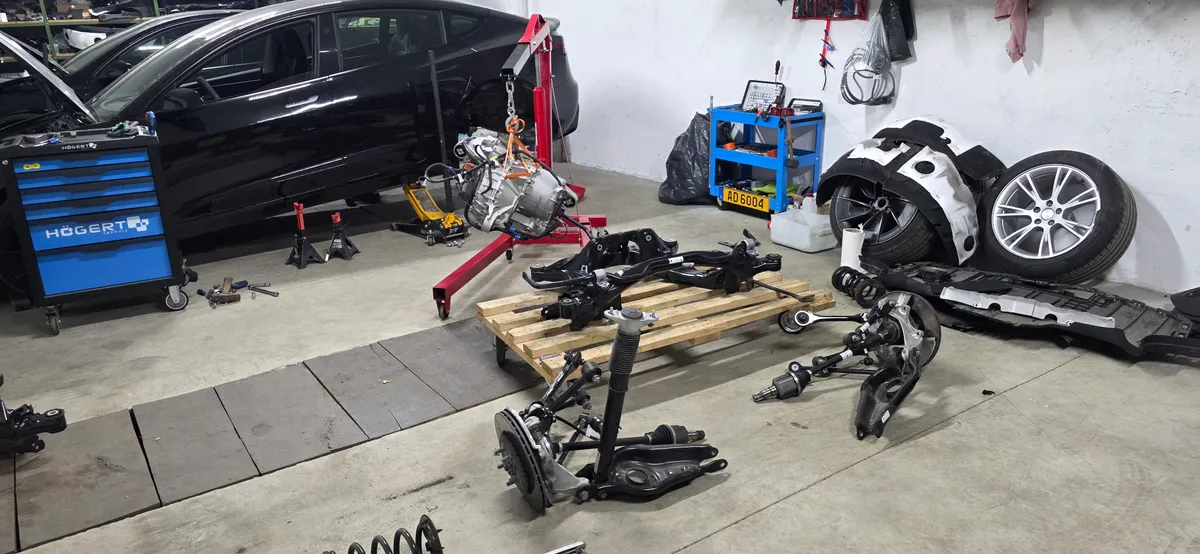
🛠️ Tools Needed for This Repair
These are the tools I personally use and recommend. Using quality tools makes the job easier and safer.
-
36mm Axle Nut Socket (12-point)
-
36mm Axle Nut Socket (12-point)
-
Breaker Bar (1/2 inch drive)
-
Breaker Bar (1/2 inch drive)
-
Torque Wrench (1/2 inch, up to 300 Nm)
-
Torque Wrench (1/2 inch, up to 300 Nm)
-
Molybdenum Disulfide Grease (CV Joint Grease)
-
Molybdenum Disulfide Grease (CV Joint Grease)
-
Jack and Jack Stands (3-ton)
-
Jack and Jack Stands (3-ton)
-
Dead Blow Hammer / Nylon Mallet
-
Wire Brush
-
Brake Cleaner
-
Tesla Half-Shaft / CV Axle (OEM) RR Car Parts 🇪🇺
-
iFixit Pro Tech Toolkit View on iFixit
We earn commissions from qualifying purchases through our affiliate partners. This helps support the site at no extra cost to you.