Tesla Air Suspension Problems: DIY Repair (2026)
Some links are affiliate links. As an Amazon Associate I earn from qualifying purchases. Check vehicle compatibility before buying. How recommendations work.
The optional air suspension system on Tesla Model S and Model X provides adjustable ride height and a smooth driving experience. When it works, it's fantastic — but when problems occur, repairs at the service center can easily run into thousands of dollars. This comprehensive guide helps you diagnose air suspension issues yourself, understand what you can realistically fix at home, and know when it's time to call in a professional.
Symptoms of Air Suspension Problems
Common signs your air suspension needs attention:
- Car sits low on one or more corners after parking overnight
- "Air suspension needs service" warning message on the touchscreen
- Compressor runs constantly — you can hear a humming or buzzing sound, especially from the front trunk area
- Uneven ride height between the left and right sides
- Suspension won't raise to higher settings (High or Very High)
- Slow height adjustment when loading passengers or cargo
- Bouncy or floaty ride — the air springs have lost damping ability
- Compressor shuts off prematurely — overheating protection triggered
Understanding the System
Tesla's air suspension consists of several interconnected components. Understanding each one helps you narrow down issues faster:
- Air compressor — Creates and maintains pressure for the entire system. Located under the front trunk (frunk) on Model S and under the rear cargo area on Model X. Generates up to 16 bar (232 psi).
- Air springs (4) — One at each corner. These rubber-and-fabric bladders replace traditional coil springs. They inflate and deflate to change ride height.
- Valve block (solenoid block) — Controls air distribution to each corner independently. Contains individual solenoid valves for each air spring plus exhaust and inlet valves.
- Height sensors (4) — Measure the vehicle's position at each corner relative to the suspension arm. Send data to the suspension control module.
- Air lines — Nylon tubing that connects the compressor to the valve block and each air spring. These run underneath the vehicle and are exposed to road debris.
- Air reservoir (dryer) — Stores compressed air and removes moisture. A failing dryer can introduce moisture into the system, corroding internal components.
- Suspension control module — The brain that processes height sensor data and controls the compressor and valve block.
Model-Specific Differences
Model S Air Suspension
- Compressor is located in the front trunk area, typically on the passenger side
- Available on all Model S trims as an option (standard on Performance/Plaid)
- Early Model S (2012–2016) used a different compressor design that's more failure-prone
- Refresh Model S (2021+) uses an updated valve block with improved sealing
Model X Air Suspension
- Compressor is located under the second-row seats or rear cargo area
- Standard equipment on all Model X trims
- The heavier weight of Model X puts more stress on the system
- Falcon wing doors add complexity — height errors can prevent door operation
- Model X compressor failures are more common due to higher duty cycle from the heavier vehicle
Diagnosing the Problem
Step 1: Check for Leaks
Air leaks are the single most common air suspension issue. A slow leak may take hours to manifest (you'll notice the car sitting low in the morning), while a sudden leak will trigger an immediate warning.
- Park on a level surface and set ride height to Standard
- Turn off the car and wait — listen for hissing sounds around each wheel well
- Mix dish soap and water in a spray bottle
- Spray all connections: the top of each air spring, the air line fittings at each corner, and the lines running along the subframe
- Bubbles indicate a leak — note the exact location
- Check the valve block connections as well (follow the lines from the compressor)
Step 2: Compressor Test
If the car sits low at all four corners:
- Turn off the car completely and wait 5 minutes
- Turn the car on (foot on brake, press start) without driving
- Listen carefully near the front trunk (Model S) or under the rear seats (Model X) for the compressor
- A healthy compressor produces a steady hum for 30–90 seconds, then stops
- No sound at all — compressor has failed, or the relay/fuse is blown
- Clicking sound only — relay is failing (cheap fix, see below)
- Compressor runs but car stays low — leak is faster than the compressor can fill, or the valve block is stuck open
- Compressor runs for more than 3 minutes continuously — significant leak or failing compressor (overheating protection will shut it off)
Step 3: Check Error Codes
Use a Tesla-compatible OBD2 diagnostic scanner or put the car in Service Mode to read suspension DTCs:
| DTC Code | Meaning | Likely Cause |
|---|---|---|
| APP_w221 | Air spring leak detected | Leaking air spring or fitting |
| APP_w222 | Compressor overheating | Compressor running too long (leak elsewhere) |
| APP_w223 | Height sensor fault | Damaged or disconnected sensor |
| APP_w224 | Valve block malfunction | Stuck solenoid or wiring issue |
| APP_w225 | System pressure low | Multiple leaks or compressor weakness |
| APP_w226 | Calibration required | After suspension work or sensor replacement |
For a complete list of Tesla error codes and what they mean, see our Warning Lights & Error Messages Guide.
Step 4: Height Sensor Inspection
Height sensors are often overlooked but frequently fail:
- Visually inspect each sensor — they're small arms attached to the suspension links
- Check for bent or broken sensor arms (road debris can hit them)
- Verify the wiring connectors are secure and free of corrosion
- A failed sensor on one corner will cause that corner to sit at the wrong height
- Sensor replacement is a straightforward bolt-on job
DIY Fixes You Can Perform
Ride Height Calibration
After any suspension work or if you're getting height-related warnings:
- Park on a flat, level surface (a garage floor works well)
- Go to Controls > Suspension > Calibrate Ride Height
- Exit the vehicle and close all doors and trunk/frunk
- Wait for calibration to complete — this takes 5–10 minutes
- The car will adjust each corner individually and confirm completion
- If calibration fails, check that no passengers or heavy cargo are in the car
Air Line Replacement
If you've found a leaking air line or push-fit connection:
- Safely lift the vehicle on jack stands using the correct jack points
- Lower the suspension to the lowest setting before lifting to reduce system pressure
- Locate the leaking air line section
- Press the release collar on the push-fit connector and pull the line out
- Cut a new section of 6mm nylon air line to length (leave 10 mm extra)
- Push the new line firmly into the fitting until it clicks — tug to verify it's locked
- Lower the car and raise the suspension — spray the new connection with soapy water to verify the seal
- Recalibrate ride height after completion
Compressor Relay Replacement
A clicking compressor often means a failed relay — one of the cheapest fixes possible:
- Locate the relay box in the front trunk area (Model S) or under the cargo trim (Model X)
- Identify the air suspension relay — consult your owner's manual for the exact position
- Pull the old relay straight out and push in the replacement
- Test by raising the suspension one level
- This fix costs under €30 in parts and takes about 15 minutes
Compressor Replacement
If the compressor itself has failed (no sound, no relay clicking):
- Disconnect the 12V battery first — see our 12V Battery Guide for location
- Remove the frunk liner or cargo trim to access the compressor
- Disconnect the electrical connector
- Mark each air line before disconnecting (take a photo for reference)
- Release the air lines from the compressor using the push-fit release collars
- Unbolt the compressor — typically 3 mounting bolts (10 mm)
- Install the new compressor, torquing mounting bolts to 10 Nm (7.4 ft-lb)
- Reconnect all air lines to the correct ports
- Reconnect the electrical connector and 12V battery
- Run the suspension through all height settings to purge air from the lines
- Recalibrate ride height
Air Spring Replacement
This is the most involved DIY job but saves $500+ per corner vs. the service center:
- Safely lift and support the vehicle on jack stands
- Remove the wheel (lug nuts: 175 Nm / 129 ft-lb for Model S, 175 Nm for Model X)
- Lower suspension to the lowest setting and disconnect the air line at the top of the spring
- Support the lower control arm with a floor jack
- Remove the air spring upper mounting bolts — typically 3 bolts at 25 Nm (18 ft-lb)
- Slowly lower the jack to decompress the spring
- Remove the lower mounting hardware
- Install the new air spring in reverse order
- Reconnect the air line and lower the car
- Recalibrate ride height — this is mandatory after spring replacement
Air-to-Coil Conversion
For owners tired of recurring air suspension failures, converting to traditional coil springs is a permanent solution:
- Conversion kits are available from companies like Arnott and Strutmasters
- You lose adjustable ride height but gain reliability and lower long-term costs
- Installation takes 3–5 hours for a competent DIYer
- The suspension control module will throw a permanent warning — some kits include a bypass module to clear this
- Ride quality changes to a firmer, more predictable feel
Repair Cost Comparison (2026 Prices)
| Component | Tesla Service Center | Independent Shop | DIY Cost |
|---|---|---|---|
| Air Spring (each) | $800–$1,200 | $500–$800 | $300–$500 |
| Compressor | $1,500–$2,000 | $800–$1,200 | $400–$700 |
| Air Lines | $500–$800 | $200–$400 | $50–$150 |
| Valve Block | $1,200–$1,800 | $600–$1,000 | $400–$800 |
| Height Sensor | $400–$600 | $200–$350 | $80–$150 |
| Compressor Relay | $200–$300 | $100–$150 | $15–$30 |
| Air-to-Coil Conversion | N/A | $1,500–$2,500 | $800–$1,500 |
For a broader overview of Tesla repair expenses, see our Tesla Repair Cost Guide.
Preventive Maintenance
Extend your air suspension's lifespan with these habits:
- Don't overload the vehicle beyond its rated capacity (check the door jamb sticker)
- Avoid deep water — puddles and road spray can damage air line fittings and introduce moisture
- Listen for changes in compressor behavior — a louder or longer-running compressor signals a developing leak
- Check ride height monthly when parked overnight on a level surface
- Avoid excessive height changes — each raise/lower cycle puts stress on the compressor
- Inspect air lines annually — look underneath for cracked or rubbing lines, especially near the rear axle
- Replace the dryer when replacing the compressor — the old dryer may have moisture contamination that damages the new compressor
- Keep the car plugged in during cold weather — the system can maintain proper pressure more easily when the 12V battery is kept charged
When Professional Help is Needed
Some jobs genuinely require a service center or experienced independent shop:
- Valve block replacement — requires coding and system initialization via Tesla Toolbox
- Height sensor recalibration — if manual calibration fails, software-level calibration is needed
- Suspension control module replacement — requires pairing to the vehicle
- Structural damage assessment — if air suspension failure was caused by an impact or accident
- Warranty claims — air suspension components are covered under the 4-year/50,000-mile warranty (check your specific coverage)
For diagnostics help, our OBD2 Scanner & Diagnostics Guide covers the best tools for reading Tesla suspension codes.
Air suspension issues can seem intimidating, but most problems come down to leaks — and leaks are fixable. Understanding how the system works puts you in control of the repair decision: fix it yourself, take it to an independent shop, or convert to coils and never worry about it again.
Related Guides
- Jack Points & Lifting Guide — Safe lift points for Model S/X air suspension work
- Suspension Noise Fix — Diagnose noises before replacing parts
- Shock Absorber Replacement — Replace shocks alongside air springs
- Control Arm Replacement — Related suspension components
- Wheel Alignment DIY — Essential after any suspension work
- Service Mode Guide — Access diagnostic menus for suspension codes
- Tesla Repair Cost Guide — Full breakdown of repair costs by component
- Tesla Parts Europe Buying Guide — Source affordable OEM and aftermarket parts
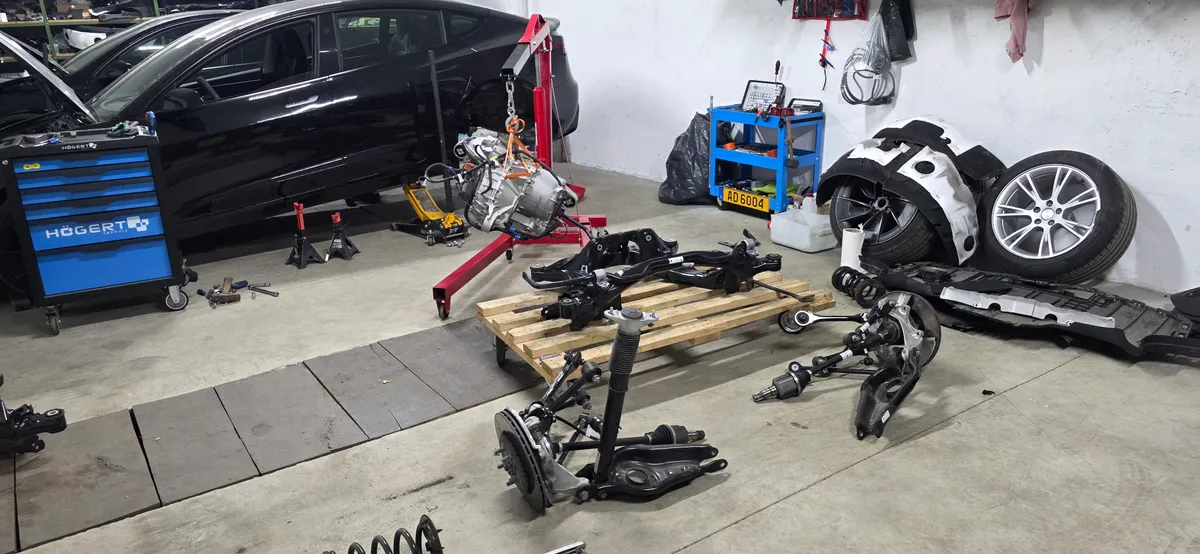
Tools and parts to check
Match the tool or part to your vehicle and the procedure before ordering. Search links show listings, not a verified fit. Check the seller's specifications, delivery region and current price.
- OBD2 Diagnostic Scanner for Tesla
- Jack Stands (3 Ton)
- Floor Jack (3 Ton)
- Soapy Water Spray Bottle
- Torque Wrench Set
- Air Suspension Compressor (Model S/X)
Some links earn a commission from qualifying purchases. Storefront availability and compatibility vary.